

How to Get a Cosmetology License: Everything You Need to Know
I know the feeling of being totally ready to dive into the beauty world, only to get hit with the realization that the legal side of things is a total maze. I've seen so many people get stuck before they even start because the instructions on how to get a cosmetology license are scattered all over the place. I want to clear that up for you. I’m going to lay out a straightforward path so you can stop worrying about the paperwork and start focusing on your future career.
The most important thing to keep in mind is that beauty licensing is handled state-by-state. While the general journey is similar, the specific details like how many hours you need or the exact fees will depend on your local board.
Verify Your State’s Specific Requirements First
Before you spend a dime or commit to a schedule, you need to know what your state board actually expects. When people look for cosmetology license requirements or general cosmetology requirements by state, they are usually trying to avoid a costly mistake.
I always recommend going straight to the source. Find the official website for your state board—it might be called the Board of Cosmetology or the Department of Professional Regulation. You’ll want to double-check the required training hours, the types of exams you'll have to take, and the current application fees.
For instance, California requires 1,000 hours of instruction for their programs. Virginia also moved to a 1,000-hour requirement at the end of 2025. Because these rules can shift, verifying the info directly with the board is the only way to be 100% sure you're on the right track.
Deciding on Your Training Path (School vs. Apprenticeship)
There are two main ways to get your education, and the right choice usually comes down to how you like to learn.
The Traditional School Route
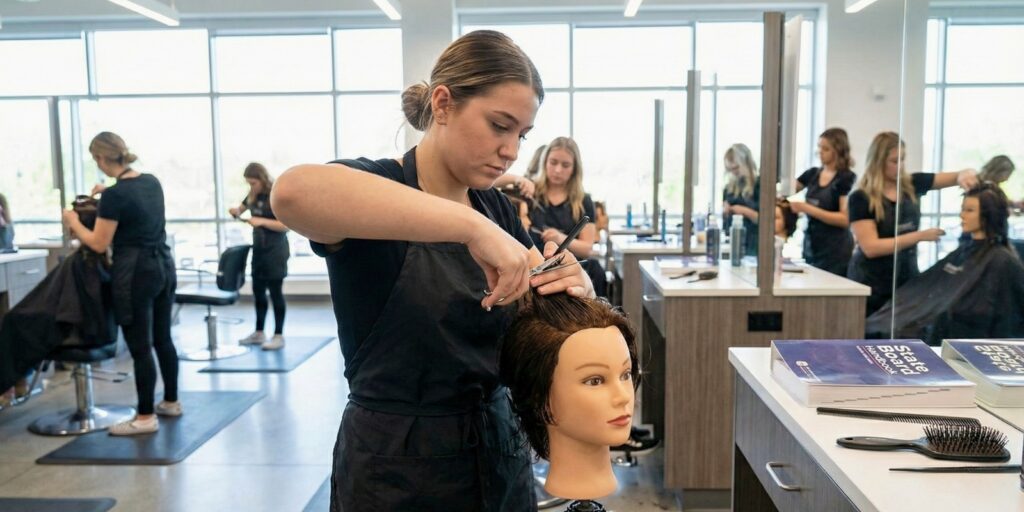
Attending a cosmetology school is the most common path. You join a program that is already approved by the state, complete your hours, and the school helps prepare you for the testing process. When I talk to students about how to enroll in cosmetology school, I always remind them to check that the school is board-approved and accredited if they are hoping to use federal financial aid.
The Apprenticeship Route
I often see people searching for a way to get a cosmetology license without school. In the beauty world, this usually means finding a cosmetology apprenticeship. This path lets you learn through a mix of hands-on, paid work experience and classroom instruction. For example, a Registered Apprenticeship is a formal model that leads to a portable credential. States like California have used this as a great lower-cost alternative to traditional schooling. If you're interested in an apprenticeship for cosmetology, check Apprenticeship.gov or your state board to see if it’s an option where you live.
Planning Your Timeline and Budget
One of the most frequent questions I get is how long does it take to get a cosmetology license. The real answer depends on your life. Your timeline is built on how many hours you need, whether you are full-time or part-time, and how quickly your state processes the paperwork. In some places, like California, a mailed application can take eight weeks, so I always suggest using online portals whenever possible.
Regarding costs, you have to budget for tuition, your kit, and the fees for your cosmetology state board exam. If you’re worried about the price, check if your school has a federal school code on the Federal Student Aid website. If you can't find a code, Federal Student Aid explains it may mean the school doesn’t participate in those programs. Also, the IRS often allows you to claim certain education expenses on your taxes if you attend an eligible trade school.
Mastering the State Board Exam
The part that usually makes people the most nervous is the actual testing. If you want to know how to pass the cosmetology state board exam, my best advice is to treat the practical portion like a performance.
Most states use exams from the NIC, and they provide Candidate Information Bulletins that tell you exactly what is on the test. Other states might use vendors like Prometric for their practicals. I tell my students to practice their setup and sanitation steps until they are muscle memory. Most people lose points on procedural things like infection control rather than the actual beauty services.
Managing Your License Long-Term
Once you have that license in hand, you need to protect it. I recommend saving your license number somewhere safe because you’ll need it for everything from job applications to renting a booth.
You also need to stay on top of your cosmetology license renewal. Every state has different rules; for example, New York licenses are valid for four years, while Pennsylvania requires you to retake the exam if your license is expired for more than five years. Texas provides an online flow for renewals, and Florida is very strict with null and void licenses. I always suggest setting a calendar reminder as soon as you get licensed.
If you ever decide to move, you’ll need to look into a cosmetology license transfer from state to state, which is often called reciprocity. You’ll usually apply for a new license in your new home based on your previous training and experience. Some boards, like California, will send official verification letters directly to your new state. Some states, like Virginia, are even working on a licensure compact to make this transition easier for pros in the future.
Handling Unique Situations
I know that things like education history or legal backgrounds can feel like a barrier, but there is usually a path forward.
- Education and Age: Most schools and boards require a high school diploma or GED, but you should always check the specific policy of the school you choose.
- Identification: If you don't have a Social Security Number, some states like California allow you to apply using an ITIN.
- Legal History: If you have a felony or misdemeanor, states like Texas often require disclosure and evaluate applications case-by-case. I always suggest contacting the board early so you don't have any surprises later.
How to Get Started Now
If you’ve been thinking about this career for a while, the best move you can make is to take that first step toward training. At Perimeter Beauty & Barber Institute, I focus on giving you a clear and structured path to meet Georgia’s state requirements. For those aiming to become a Master Cosmetologist, we follow the state-mandated 1,500 hours to ensure you are fully prepared for the board.
We also offer specialized tracks if you want to focus on a specific area. We have a 1,000-hour Esthetician program, a 600-hour Nail Technician program, and a 1,500-hour Master Barber program. For those looking to move into education, we also provide a 750-hour Instructor training program.
If you are ready to stop wondering and start doing, you can find more details on our Enrollment page. I’d love to help you figure out which path is right for your goals. You can also fill out the contact form right below this article, and someone from our team will reach out to help you map out your best path forward.