

Nail Tech Client Forms, Safety Policies, and Service Guidelines
What Nail Technicians Should Remember
- Safety Screening and Documentation: Client consultation forms help nail technicians identify allergies, service-related health concerns, and existing natural nail damage before beginning a service while maintaining a useful record of observations and conversations.
- Professional Boundaries Protect Your Business: Clear policies covering cancellations, deposits, late arrivals, payments, and communication help prevent misunderstandings, protect scheduled appointment time, and establish expectations with clients.
- Working Within Your License: Nail technicians must remain within the cosmetic scope authorized by their license and recognize situations involving compromised skin or nails that may require modifying, postponing, or refusing a service. Specific requirements vary between states.
- Reducing Preventable Product Reactions: Careful consultation, appropriate product handling, correct curing, and preventing uncured nail products from touching the skin can reduce the risk of Acrylate Allergic Contact Dermatitis. Technicians should also understand their state's requirements concerning products such as Methyl Methacrylate (MMA).
Stepping behind the manicure table for the first time brings both excitement and a certain amount of uncertainty. While developing nail-art techniques and improving builder gel application are important, a sustainable professional career also depends on setting client boundaries, carrying out consistent consultations, and maintaining reliable records. These practices work alongside your technical abilities to support safer services, protect your appointment time, and establish expectations from the beginning.
Building Salon Policies That Protect Your Time and Clients
Setting expectations before an appointment begins can prevent many uncomfortable situations later. Transparent nail technician policies covering cancellation windows, deposits, late-arrival grace periods, payment terms, and communication practices help clients understand how your business operates while protecting your scheduled time and income.
Clear rules can also simplify routine communication. New clients may feel uncertain about booking an appointment or requesting detailed nail art. Written guidelines reduce repeated conversations about pricing, timing, deposits, repairs, or which inspiration photos should be sent before the appointment.
Policies become especially useful when they are enforced consistently. Instead of deciding how to respond differently each time a client arrives late, misses an appointment, changes a service, requests a refund, or asks for a repair, you already have a documented standard to follow. Establishing these boundaries early can make everyday client management much more predictable.
According to a Research and Markets industry report, the global nail salon market is estimated at $14.08 billion in 2026, compared with $12.98 billion in 2025, with increased attention to hygiene and safety standards identified among developing industry trends. A separate Grand View Research analysis highlights growing consumer awareness of ingredient safety, sustainability, and clean-beauty nail products. While these reports do not establish that every client expects the same standards, they reinforce the value of transparent safety practices, professional consultations, and clearly communicated salon policies.
Client Intake Forms: What Nail Techs Should Ask and Record

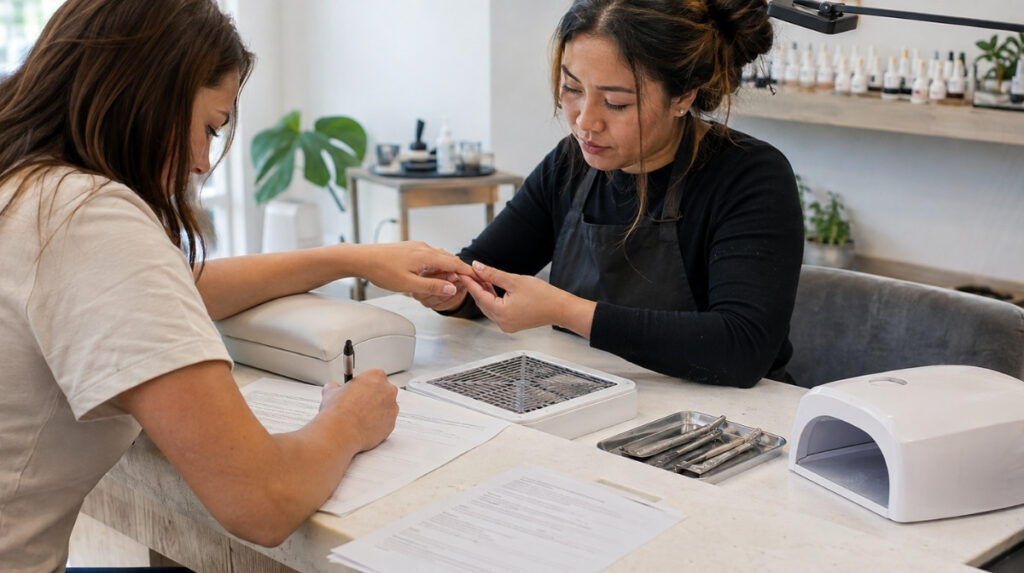
A client intake form can function as a practical health and service-screening tool. Written consultation forms are not legally required in every state, but they provide a consistent way to gather relevant information before products are applied or a service begins. For first-time clients, the form creates a baseline that can later be updated when allergies, medications, health history, nail condition, or previous product reactions change.
- Screening for Allergies: An intake form should ask whether the client has previously reacted to gel products, acrylic systems, nail adhesives, primers, solvents, or other nail products. Acrylate and methacrylate monomers are reactive ingredients present in many nail systems. Repeated exposure, uncured material touching the skin, or improper curing can contribute to allergic sensitization and Acrylate Allergic Contact Dermatitis.
- Tracking Service-Relevant Health Conditions: Diabetes, peripheral neuropathy, and circulation problems can influence service decisions, particularly during pedicures. The Centers for Disease Control and Prevention explains that diabetes can damage nerves and reduce blood flow to the feet, meaning injuries may go unnoticed and some wounds can be harder to heal. Nail technicians should not diagnose these complications, but a disclosed medical history may justify performing a more conservative service or recommending medical evaluation when concerning signs are present.
- Checking for Previous Nail Damage: Ask about previous nail enhancements, recent removals, injuries, or painful salon services. Someone who recently pulled off acrylic enhancements or experienced aggressive filing may have a thin, tender, or visibly compromised natural nail plate. Identifying this history before beginning helps determine whether the requested enhancement is appropriate or should be modified or delayed.
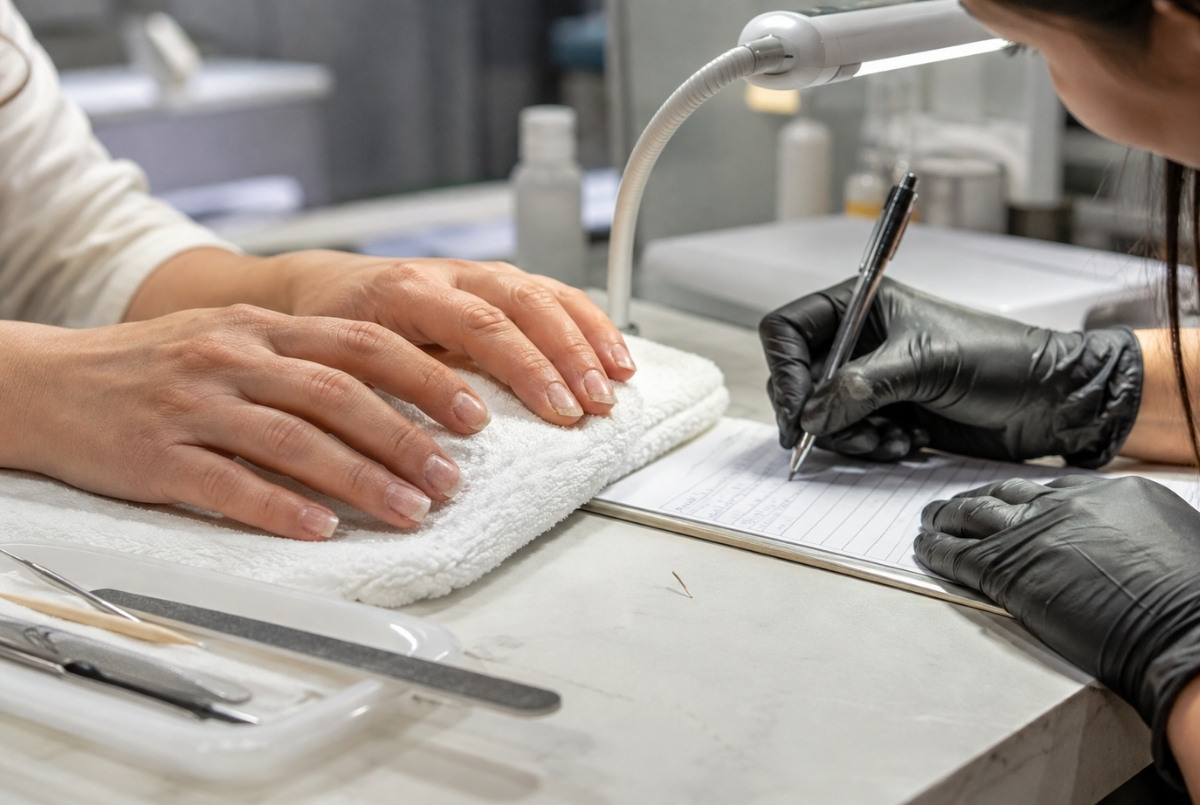
- Creating a Service Record: Client documentation can include the nail system or products used, visible nail or skin changes, reactions that occurred during the appointment, service adjustments, and whether a professional referral was recommended. Record observations rather than attempting to identify a medical condition.
Research featured in PubMed / Nursing for Women's Health discusses Acrylate Allergic Contact Dermatitis as a growing concern among manicure consumers and professionals, with repeated acrylate exposure and improper curing identified as important risk factors. Reactions may include redness, swelling, itching, dermatitis near the nails, and nail changes such as onycholysis. After sensitization develops, later exposure to the same or related acrylates may cause additional or recurrent reactions, so a confirmed allergy should be taken seriously.
The issue can extend beyond nail services. A review of acrylate exposure explains that acrylates and methacrylates are also used in dentistry and numerous medical products, while published literature has identified acrylate allergens in certain wearable glucose-monitoring devices and adhesives. Having an acrylate allergy does not automatically prevent someone from receiving dental treatment, surgery, or using a medical device. However, anyone with a confirmed allergy should inform the appropriate healthcare professionals so the specific allergen and possible material alternatives can be evaluated.
Marketing claims about nail products also require careful interpretation. A product described as "HEMA-free" should not automatically be considered "allergy-free" because HEMA represents only one possible methacrylate sensitizer. In a laboratory study published in Contact Dermatitis and indexed by PubMed, researchers examined 31 gel nail products and six acrylic products. Thirty-two of the 37 products contained methacrylates, and all 32 showed discrepancies between the methacrylates detected during testing and those identified on the packaging. HEMA was found in 20 of the 37 samples. The practical lesson is that marketing language should never be treated as permission for skin exposure. Keep uncured products away from the skin, use compatible products within a system, and follow the manufacturer's application and curing directions.
Recognizing When a Nail Service Should Be Changed or Stopped
Understanding your professional scope means recognizing the legal limits of your license. State requirements differ, but nail technician licensing generally covers cosmetic nail services rather than medical diagnosis or treatment. In Georgia, the legal definition of nail technician services covers manicures, pedicures, trimming, filing, shaping, decorating, artificial nail extensions, and care of another person's nails, while Georgia State Board facility rules require cosmetology services to be performed only on intact, healthy skin and nails.
When assessing a client, focus on recognizing unusual signs rather than deciding what medical condition may be causing them. Depending on state requirements and the condition observed, a nail technician may need to modify, postpone, or refuse a service. Examples can include:
- Unexplained nail discoloration, thickening, crumbling, lifting, or distortion that may be associated with infection, disease, or significant trauma
- Skin surrounding a nail that is swollen, hot, intensely red, painful, or draining
- Open sores, broken skin, bleeding, substantial irritation, or a spreading rash within the service area
- Green discoloration underneath a separated nail plate or lifted enhancement, which may be associated with bacterial colonization and should not be diagnosed or covered with another nail product by a nail technician
A useful professional principle is to record what is visible rather than assigning a diagnosis. For example, write "green discoloration beneath a lifted nail" or "red, swollen skin with drainage" rather than documenting "Pseudomonas," "fungus," or "paronychia" unless a qualified healthcare professional has already provided that diagnosis. If an observed condition appears outside the cosmetic scope of nail services, postpone the procedure when appropriate and recommend that the client consult a podiatrist, dermatologist, physician, or another qualified healthcare provider.
Requirements differ between jurisdictions, but many states restrict services when the skin or nails are compromised. Georgia requires cosmetology services to be performed only on intact, healthy skin and nails. Arkansas regulations similarly restrict practitioners from knowingly working on clients with certain infectious or communicable conditions and prohibit massage on skin that is inflamed, open, irritated, infected, or affected by an eruption. The requirements can be reviewed through the Georgia State Board rules and the official Arkansas cosmetology regulations.
Nail professionals interested in working with health-conscious or medically vulnerable clients may explore medical nail technician training and certification for additional education involving risk awareness, infection prevention, and appropriate referral practices. Advanced private certification, however, does not expand the scope granted by a state-issued nail license or authorize medical diagnosis or treatment.
Refusing a service can be uncomfortable, particularly for a newer professional. Explain what you observed, clarify that performing the requested service may not be appropriate on compromised skin or nails, and avoid claiming to know the medical cause. Recommending evaluation by a podiatrist, dermatologist, physician, or other healthcare professional allows you to respond responsibly without moving beyond your professional scope.
Guidance from the Connecticut Department of Public Health illustrates how detailed salon infection-control requirements can become. Connecticut does not recognize UV sterilizers or light boxes as acceptable infection-control devices, while UV electric sanitizing cabinets may be used only as dry storage for items that have already been properly disinfected. The state's guidance also prohibits skin-cutting devices such as razor-type callus shavers and Credo blades. Georgia similarly prohibits razor-type callus shavers.
Reusable tools and hard surfaces should be handled according to both state requirements and the instructions on the disinfectant label rather than one assumed universal contact time. The U.S. Environmental Protection Agency explains that contact time is the amount of time a surface must remain visibly wet for a disinfectant to work against the organisms listed on its label. The required duration differs between products. If a label requires 10 minutes, the treated surface must remain visibly wet throughout those 10 minutes.
Managing Client Changes, Complaints, and Industry Concerns
As your experience grows, you may encounter difficult client interactions or observe practices within the industry that raise legitimate safety or licensing concerns. Responding appropriately to these situations is part of maintaining professional standards.
Clients may decide to leave a salon because of sanitation concerns, unexpected costs, poor communication, or an unsatisfactory service. Understanding how to break up with your nail technician politely can help clients move on without unnecessary conflict, while clearly published salon policies reduce confusion when professional relationships end. A practical nail technician questions and answers section on your website can also help new clients understand what they should ask before booking.
Maintaining client trust also involves explaining your own hygiene procedures and aftercare expectations. Helping clients understand how cross-contamination is reduced during appointments and how they should care for their nails afterward can make safety practices easier to understand and follow.
Nail technicians should also know where to report suspected licensing or safety violations. Reporting should focus on issues within the jurisdiction of the applicable licensing authority, including possible unlicensed practice or violations of licensing and safety requirements. In Georgia, the State Board of Cosmetology and Barbers complaint process accepts written complaints concerning possible licensing violations and unlicensed activity. Ordinary disputes involving prices, fees, or contracts generally fall outside the Board's jurisdiction, so a disagreement about a refund or service charge does not automatically constitute a licensing violation.
Another product-related issue technicians should understand is Methyl Methacrylate, commonly known as MMA. MMA is not universally prohibited under federal cosmetic law. The U.S. Food and Drug Administration states that no federal regulation specifically prohibits methyl methacrylate monomer in cosmetic products. After receiving injury complaints associated with artificial-nail products containing 100% MMA monomer in the early 1970s, the FDA pursued court actions, seizures, and recalls. Individual states may separately prohibit or restrict MMA in professional nail services.
Information from the Arizona Barbering and Cosmetology Board explains why MMA remains an important concern. The Board notes that MMA may cost roughly one-third as much as Ethyl Methacrylate, or EMA, and can create enhancements that become extremely hard and difficult to file or remove. Technicians should not attempt to identify MMA solely from salon pricing or assumptions about a particular business. Instead, understand your state's restrictions, purchase professional products through traceable suppliers, keep product information accessible, and use the proper regulatory complaint process when necessary.
Common Questions About Consultation and Salon Policies
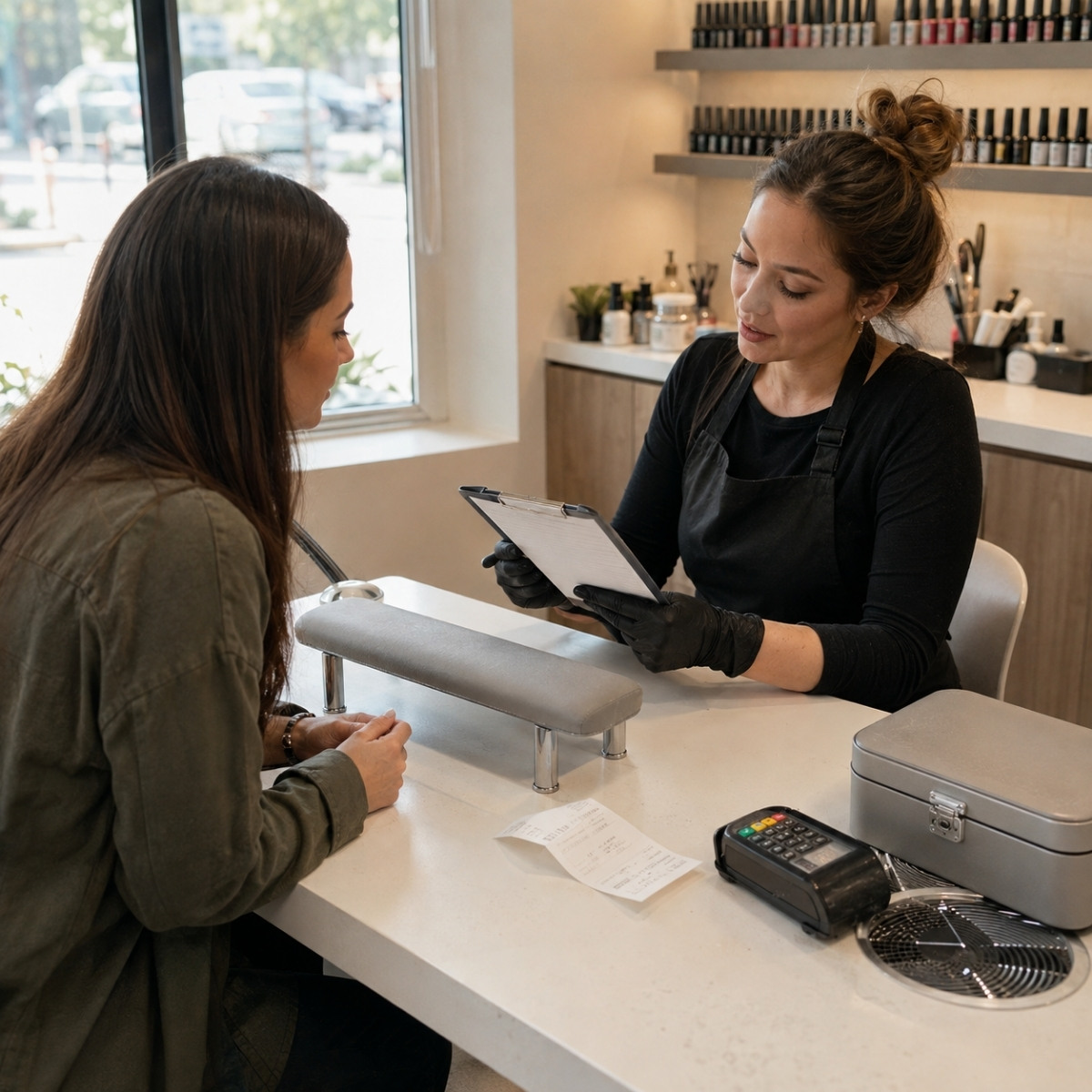
How long should client intake forms be kept? There is no single nationwide retention rule for nail-client consultation forms. Review applicable state requirements, professional liability insurance terms, and your business record-retention practices. Health and consultation information should be stored securely, and whichever retention schedule applies should be followed consistently.
Can consultation forms be customized for services such as hard gel or pedicures? Yes. A general intake form can collect baseline information about allergies, previous reactions, and relevant health history, while additional service-specific sections can document information that matters for extensions, gel systems, pedicures, or other procedures. Recording which products were used and updating the client's information when circumstances change can also make the record more useful.
What happens if a client will not complete an intake form? Explain that the form is part of your consultation and safety procedure. If a completed form is required by your salon policy, applicable state requirements, or insurance terms, do not perform the service without it. Even when a specific written form is not legally required, postpone or decline the service if you do not have enough information to determine whether it can be performed appropriately within your scope.
Prepare for Professional Nail Work With the Right Foundation
Building a successful nail career requires more than precise polish application. Professional judgment, client communication, safety awareness, and practical business habits are also important parts of working in the beauty industry. To learn more about hands-on training and preparation for a career in beauty, visit our Enrollment page.
If you have questions about training or would like to discuss your future career path, fill out the contact form at the bottom of this page to connect with our team.