

Attending Cosmetology School While in High School – Programs, Costs, and State Rules
Essential Points Before You Begin
- Early Training Depends on Eligibility: Certain states provide opportunities to study cosmetology before high school graduation, but students must meet the requirements of both the state and the institution.
- Approved Vocational Programs May Offer a Head Start: CTE and dual-enrollment arrangements can sometimes reduce expenses and provide recognized licensing hours. Neither funding nor hour acceptance is automatic.
- Enrollment Does Not Equal Licensing Eligibility: Starting a course, qualifying for an examination, and obtaining a professional credential can involve different age and education standards.
- Beauty Education Includes Several Disciplines: A cosmetology course usually combines hair techniques with basic skin and nail services, infection prevention, client care, and salon operations.
Balancing traditional academic classes while dreaming about a future in beauty can feel frustrating when you are eager to start practicing. Fortunately, some students can explore professional training before their final year of high school is over. An eligible early-training arrangement may help you develop practical skills and finish part of your beauty education ahead of schedule.
The important question is not simply whether a program welcomes teenagers. You need to know whether you qualify, whether the completed work will count toward a license, and whether the timetable leaves room for your remaining high school courses. Those details determine whether starting early will actually move your plans forward.
When Can You Begin Professional Beauty Training?
If you are wondering how old you have to be for cosmetology school, the answer depends on where you live and which institution you choose. States set their own standards for beauty training and professional licensing. Schools then apply admission policies that may go beyond those legal minimums.
There are several checkpoints along the way. Admission to a classroom program, registration for an apprenticeship, approval to take an examination, and issuance of a license are separate decisions. Being old enough for one does not necessarily make you eligible for the others.
For example, the South Carolina Board of Cosmetology lists a minimum age of 16 and at least a 10th-grade education or an accepted equivalent for cosmetologist applicants. Its school-based route requires 1,500 hours at an approved cosmetology school, followed by the required examinations and application steps.
The Alabama Board of Cosmetology and Barbering similarly requires examination candidates to be at least 16. Applicants must document completion of the 10th grade or a higher educational qualification, along with their completed beauty training.
California provides another useful comparison. The California Board of Barbering and Cosmetology generally requires cosmetology examination applicants to be at least 17 and to have finished the 10th grade or its equivalent. Its approved apprenticeship route, however, permits applicants to begin at 16 after meeting the 10th-grade education requirement or its equivalent and the other apprenticeship conditions.
To understand how those legal standards interact with individual school policies, review cosmetology admissions qualifications and the different ways applicants may become eligible. The Natural Healers licensing guide can also provide background information, but the relevant state board should remain your main source for current rules.
Arkansas generally requires prospective cosmetology students to be at least 16 and to have completed two years of high school or an equivalent education. Check the latest enrollment requirements with the Arkansas Department of Health Cosmetology Section before applying.
Georgia also separates permission to learn from eligibility to practice professionally. Georgia Code § 43-10-14 allows individuals who are at least 16 to learn cosmetology in an authorized school setting under a qualified instructor or through a registered apprenticeship.
For master cosmetologist licensing, Georgia Code § 43-10-9 generally requires an applicant to be at least 17, possess a high school diploma, state-approved equivalency diploma, or postsecondary degree, complete the prescribed school course or apprenticeship, and pass the required examinations. A school's admission requirements can still be stricter than the minimum age permitted for training.
What Should Applicants Younger Than 18 Expect?

Students under 18 can attend cosmetology programs where their age, education, and chosen school's rules allow it. However, the paperwork may require involvement from a parent or legal guardian.
Rules governing a minor's ability to enter an enforceable agreement vary by jurisdiction and circumstances. Schools therefore commonly request an adult's signature on enrollment, tuition, or consent documents. Ask admissions which forms require a parent or guardian rather than assuming the same procedure applies everywhere.
You may also need identification, proof of age, and official educational records. Some institutions accept the grade level permitted by their state, while others require a diploma or GED before enrollment.
Examination requirements deserve a separate check. Depending on the state, licensing can involve a written test, a practical assessment, or both. California eliminated its practical licensing examination requirement effective January 1, 2022, as explained in the Board's examination guidance. Completing training does not remove any other age, education, or application conditions.
Ways to Combine High School With Beauty Education
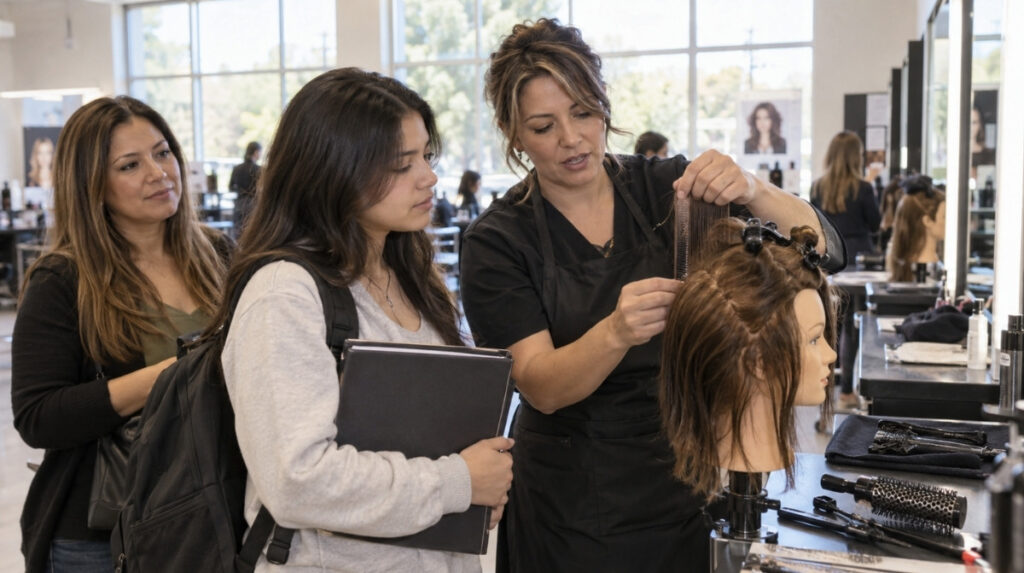
A high school with cosmetology classes may deliver training through its own vocational department, a regional career center, or a partnership with a technical college. Other possibilities include private beauty schools with compatible schedules and, where permitted, registered apprenticeships. Each arrangement has its own admission standards and rules for recognizing completed work.
Public school partnerships sometimes divide the day between academic subjects and supervised beauty instruction. This can give students access to professional equipment and practical lessons while they continue working toward their high school diploma.
The Technical College of the Rockies high school cosmetology program, for example, describes a half-day concurrent-enrollment format lasting four semesters and providing 1,211 hours over two school years. Its published 2026–2027 program cost exceeds $10,000. That example shows why concurrent enrollment should not be treated as a promise of free training.
Financial arrangements differ among districts and institutions. Public funding may cover some tuition, but families can still be responsible for tuition balances, tools, textbooks, uniforms, transportation, or examination fees. Request an itemized cost sheet that separates financial support from charges you must pay yourself.
Private academies can be worth investigating, but do not assume they offer evening, weekend, or part-time attendance suitable for high school students. Their education requirements may also exclude applicants who have not graduated, even when state law permits younger students to begin elsewhere.
An approved pathway may allow you to leave high school with a diploma and a meaningful portion of your licensing education completed. For help estimating what remains afterward, explore cosmetology completion timelines and the factors that can extend them.
Before enrolling, obtain clear answers to these questions:
- Does the state board recognize this specific program?
- How many hours will be documented as eligible cosmetology training?
- How will the classes affect high school credits and graduation requirements?
- Which expenses are funded, and which must the family cover?
- Will additional beauty-school attendance be necessary after high school?
- What documentation will be available if the student changes institutions or states?
The Skills Behind a Modern Beauty Career
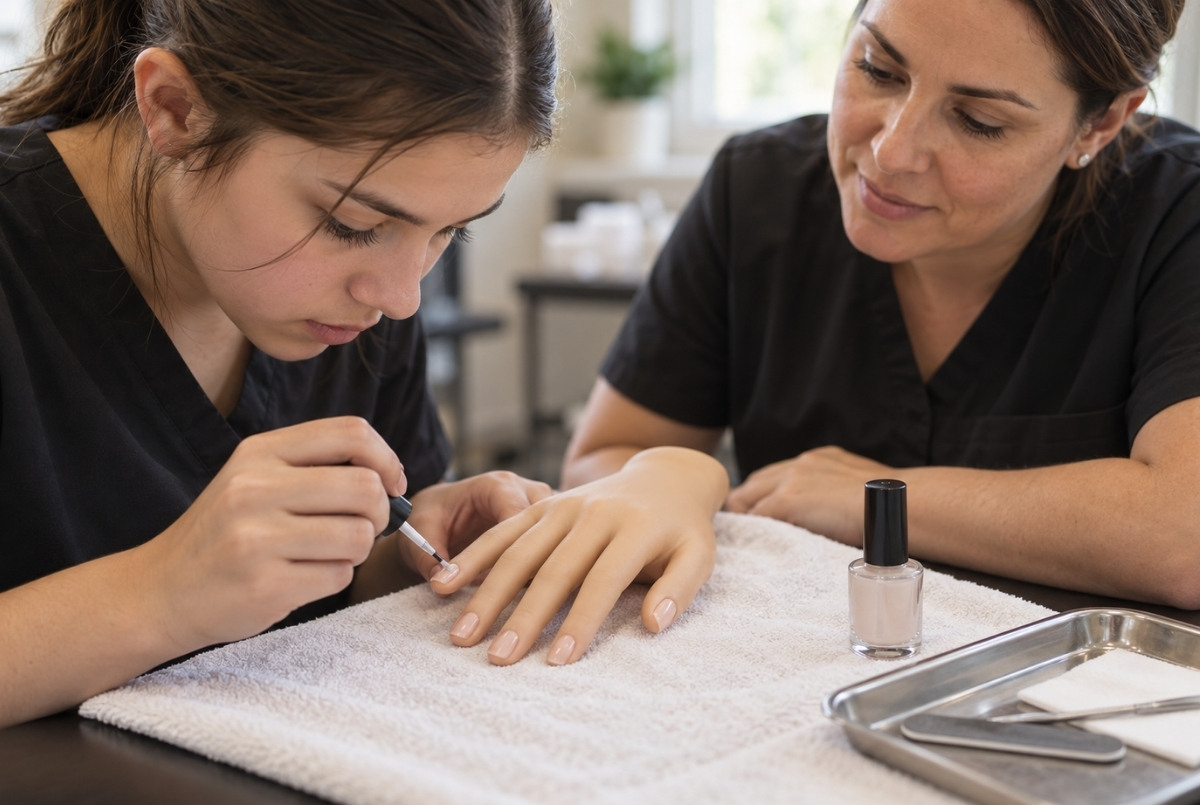
Cosmetology education is broader than learning to cut and style hair. Students generally study chemical services, hygiene, infection prevention, client protection, introductory skin care, and nail services. The required subjects and allocation of training hours depend on state rules and the approved course.
The Georgia cosmetology curriculum regulations establish a 1,500-hour master cosmetology course. Students first complete 250 hours of Level 1 instruction, including theory and mannequin work, before performing clinical services on patrons.
If skin treatments are your main interest, compare cosmetology with a dedicated esthetics program. Georgia's separate 1,000-hour esthetician curriculum concentrates on subjects such as skin sciences, facial treatments, hair removal, makeup, and professional practices. A nail technology program similarly provides a more focused route for students who primarily want to work with nails.
Specialized instruction does not automatically authorize every service associated with beauty or wellness. Lasers, injections, certain exfoliation procedures, and other medical-aesthetic treatments may require a different license or additional legal authority. A private certificate alone does not override the state's scope-of-practice restrictions.
Professional preparation also involves communicating with clients, organizing appointments, maintaining records, recommending products, and understanding salon operations. These skills can support future independent work, but operating a business may involve establishment licensing, local permits, insurance, and other obligations beyond obtaining an individual cosmetology license.
The employment outlook provides context for students considering skin-focused careers. The U.S. Bureau of Labor Statistics report on skincare specialists projects 9% employment growth between 2025 and 2035, compared with 3% across all occupations. It also estimates an average of approximately 14,200 openings annually during that period. Those openings include replacement needs when workers leave the occupation or workforce; they are not all newly created jobs.
Independent work is another established feature of the field. A 2022 submission by the American Association of Cosmetology Schools, drawing on 2020 data, reported self-employment among 33% of workers in personal appearance occupations, versus 6% of the overall workforce. These historical, industry-wide figures do not describe the prospects of a particular teenager or guarantee immediate business readiness after graduation.
A Practical Checklist for Planning Your Next Move

A little preparation can help you explore beauty training without losing sight of your current education.
- Separate the legal checkpoints. Confirm the age and education rules for school entry, apprenticeship registration, examinations, and licensing.
- Investigate relocation before transferring. Review cosmetology requirements across states, including training and transfer conditions. Moving unfinished coursework is different from seeking recognition of an existing license.
- Meet with your guidance counselor. Ask about approved CTE options, concurrent enrollment, credit recognition, and any effect on graduation or college-admission plans.
- Compare actual school schedules. Request the current attendance calendar instead of assuming that evening, weekend, or part-time classes are available.
- Prepare your application records. Find out which transcripts, identification documents, age records, and guardian signatures the school requires.
- Get recognition and costs in writing. Confirm program approval, accepted licensing hours, financial assistance, remaining expenses, and any training needed after high school.
State-board approval and institutional accreditation serve different purposes. Accreditation may matter for educational oversight and eligibility for financial assistance, but it does not, by itself, require another school or state to accept your hours.
Questions Students and Families Often Ask
Could I lose completed training hours when relocating?
It is possible that some hours will not be accepted. The receiving board or institution may review official records of your partial out-of-state cosmetology education, compare subjects and hours, and require further training. Ask for a written evaluation and explain that you are transferring unfinished education, not an active professional license.
Is federal student aid available while I am attending high school?
Students who remain enrolled in high school generally are not eligible for federal Title IV assistance, including Pell Grants, for concurrent postsecondary attendance. Other support may be available through district CTE funding, state dual-enrollment arrangements, institutional scholarships, or private programs. Ask who pays each charge and whether the assistance applies to your specific enrollment situation.
Can vocational beauty classes fit into a future college application?
They can, but credit recognition depends on your school and academic plan. Cosmetology classes may satisfy certain elective or vocational requirements without replacing the core subjects expected by your intended colleges. Do not assume that postsecondary beauty-school credits will count toward a bachelor's degree; the receiving college decides whether and how to accept them.
Does my eighteenth birthday change my enrollment responsibilities?
In many jurisdictions, turning 18 allows students to handle their own enrollment documents, but contract capacity and school procedures depend on applicable law and the agreement involved. Ask admissions whether any paperwork needs updating. Your birthday does not waive required training, education, examinations, or licensing applications.
What makes an early-training option a worthwhile choice?
Look at the recognized hours you will earn, the amount you must pay, the impact on your school schedule, and the training still required afterward. A useful program should advance your licensing education without creating avoidable graduation delays or leaving you with hours that cannot be applied to your next step.
Explore Your Eligibility at Perimeter
National early-training opportunities do not mean that every beauty school accepts students who are still completing high school.
Perimeter Beauty & Barber Institute currently publishes a minimum admission age of 16 and requires a high school diploma or GED. Its admissions page also lists photo identification and a Social Security card, plus a birth certificate for applicants under 18. Official transcripts may receive case-by-case consideration, but the school specifies that they must show a graduation date.
Being 16 therefore does not, by itself, establish eligibility to enroll at Perimeter before high school graduation. If you are still completing secondary education, speak with admissions about the published requirements and the documents needed for your situation.
Visit the Perimeter enrollment page to review the application process. You can also use the contact form below to ask about your eligibility, discuss the current timetable, or arrange a campus visit.