

Barbering and Cosmetology: Decoding the License, Training, and Career Differences
If you are standing at a career crossroads that feels more like a legal maze, I totally get it. It’s a common source of stress: that nagging fear that choosing one path - either barbering or cosmetology - will lock you into a single lane forever. You aren’t just picking a school; you are deciding on your daily lifestyle and the legal limits of what you can actually do for your clients.
In 2026, those old-school walls between a traditional barbershop and a high-end salon are basically disappearing. Modern clients don’t choose a pro based on the sign hanging over the door; they choose based on expertise. Whether you want to master the science of hair chemistry or the sharp precision of a straight-razor shave, your first move is understanding which license gives you the most power for your five-year career plan.
Quick Takeaways for Future Pros
- The Hybrid Edge: In 2026, the highest earners are "Hybrid Specialists" who know how to mix clinical skin health with precision barbering.
- Freedom to Move: The new Cosmetology Compact now lets professionals in participating states work across state lines without having to retake their exams.
- The Grooming Boom: Enrollment for male-focused grooming has jumped by 21%, turning traditional "barbering" into a high-end wellness service.
- The Crossover Shortcut: If you already have one license, you can usually pick up the second one in just 200–400 hours through a bridge program.
The Legal Side of Things (Making the Safe Choice)
I often get asked: does barbering fall under cosmetology in a legal sense? While they are close relatives, they are actually handled by different regulations. In the U.S., your state board is the one that tells you exactly which tools you are allowed to touch. Because this license covers everything from hair and skin to nails, the range of careers you can pursue with a cosmetology license is surprisingly broad. You could end up in a luxury spa, on a film set, or even in a medical aesthetics office.
Planning for the long term also means having a strategy for barbering and cosmetology license renewal. In 2026, keeping your license "legal" is about more than just a fee; it involves staying up to date with specialized education. If you decide to go for a dual license, you’ll have a bit more paperwork, but you also triple your value. You become the pro who never has to say "no" to a client.
💡 Expert Insight: The 2026 Multi-State Compact
The days of being "stuck" in one state are over. According to the Alabama Board of Cosmetology & Multi-State Regulatory Update, the Cosmetology Compact is officially live. This deal allows pros in states like AZ, CO, TN, and KY to keep a multistate license. This gives you the freedom to move your career across the country without the nightmare of bureaucratic re-testing. Your education is now a mobile asset.
Training and Skills (Choosing Your Expertise)
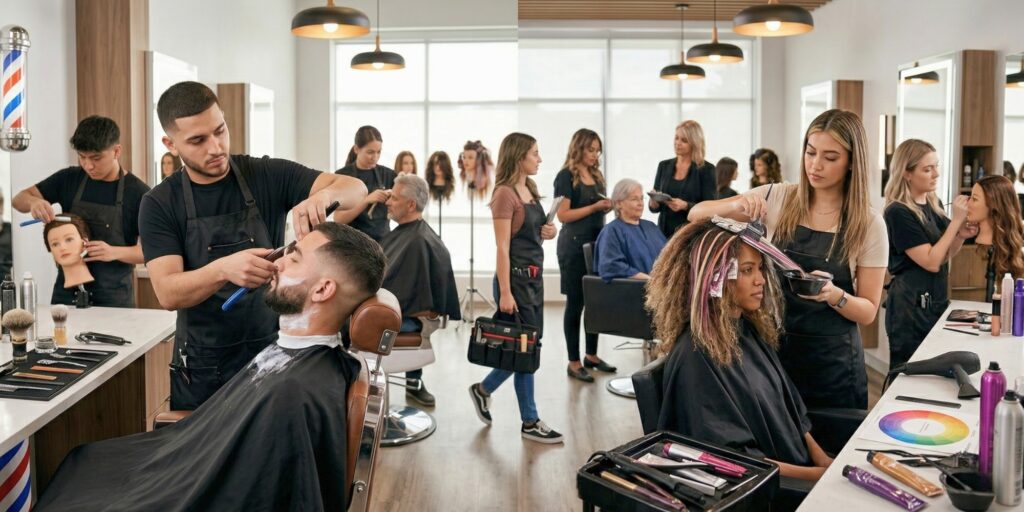
When you walk into a barbering and cosmetology school, you’ll notice the paths split pretty quickly. I like to think of a cosmetology program as a "total package" degree in aesthetics. You’ll dive deep into skin barriers and the complex chemistry behind pH-balanced hair color. You aren't just styling; you’re managing the actual health of the hair and performing clinical-grade facials.
On the other hand, the barbering vs haircut distinction is really about the tools and the tradition. Barbering is the art of the blade. It’s all about the architecture of the face and specific hair growth patterns.
I’ve seen a massive shift in who is actually in the classroom lately. Data from Global Growth Insights shows a 21% surge in male-focused enrollments recently. This isn't just about simple buzz cuts anymore; it’s about a new generation realizing that "Male Grooming" is now a high-ticket luxury category. If that artistic precision is what you're after, I recommend checking out this roadmap to starting a career in barbering to see how those skills translate into a real job.
The Crossover Strategy (The Power Move)
The most successful pros I see in 2026 are "Hybrid Specialists." While a cosmetology license gives you a lot of range, people still ask: can you be a barber with a cosmetology license? For cutting hair, the answer is usually yes, but for using a straight razor, it’s almost always "no." This legal gap is exactly why so many people look into getting barber license after cosmetology.
If you already have one license, don’t stress about "starting over." Barber license after cosmetology (or the other way around) is usually much faster through "Crossover" programs. These let you apply your existing hours toward a second credential, often only requiring an extra 200–400 hours. It’s the fastest way to make sure you can legally offer everything from a balayage to a hot-towel shave. Before you jump in, though, you’ll want to look at the actual barber school costs and hours to make sure the schedule works for you.
💡 Expert Insight: The Shift to Scalp Health
The 2026 market has moved from simple "beauty" to "wellness." Reports from America’s Beauty Show highlight that things like biotech scalp treatments and peptide serums are the fastest-growing revenue streams right now. Clients are willing to pay a premium for scalp health. Mastering this "clinical" side is what separates a standard stylist from a high-earning specialist.
Barbershop vs. Salon (The Lifestyle Choice)
Deciding between a barbershop and salon difference is mostly about your personal "vibe." Barbershops usually have a high-energy, social atmosphere with a lot of walk-in traffic. Salons are usually more about appointments and long transformations that might take several hours.
The numbers really support taking a specialized approach. The BLS 2025/2026 update shows that while barbers often have a slightly higher median wage, the real growth is in specialized skin care. By combining the precision of barbering and hairdressing, you put yourself in the highest earning category in the industry.
Ready to Build Your Own Legacy?
Choosing a career in the beauty world is about so much more than just learning to cut hair - it's about finding your place in a thriving, multi-billion dollar economy. At Perimeter Beauty & Barber Institute, we don’t just train you to pass a state exam. We want to make sure you’re ready for the day you walk into an elite salon or a modern grooming lounge.
Our "Salon Ready" philosophy is built on over 20 years of experience in the Georgia beauty community. I believe in balancing technical precision with the business smarts you need to actually make money and grow. Whether you’re looking for high-ticket salon transformations or the precision-driven culture of modern barbering, we’re here to help you get there.
If you’re ready to see how this all works in person, you can find out more about our next steps and how to join us on our Enrollment page. I’d love to help you map out your journey - just fill out the contact form below this article, and let's get started on building your legacy together.
FAQ: Professional Deep-Dive
Q: Can you do barbering with a cosmetology license?
A: You can definitely cut and style hair, but most states strictly reserve "open-blade" facial shaving for licensed barbers. Cosmetologists are usually limited to using safety razors or shears.
Q: Does barbering fall under hospitality?
A: Not exactly. While it is a service industry, it is legally categorized under "Personal Care" and is governed by professional licensing boards rather than hospitality regulations.
Q: How long is a crossover program for barbering of cosmetology?
A: If you already have one license, a bridge program usually takes about 8 to 12 weeks (200-400 hours), depending on what your specific state requires.
Q: Is this industry actually recession-proof?
A: While nothing is 100% certain, "Personal Care" is one of the most resilient industries out there. I’ve noticed that people almost always prioritize their grooming, even when they’re cutting back on other expenses.
Q: What is the main benefit of the 2026 Multistate Compact?
A: It saves you a ton of time and money. It removes the need to pay for multiple state licenses or retake exams if you move between participating "Compact" states.