

Beauty Instructor Training: How Salon Pros Learn to Lead the Classroom
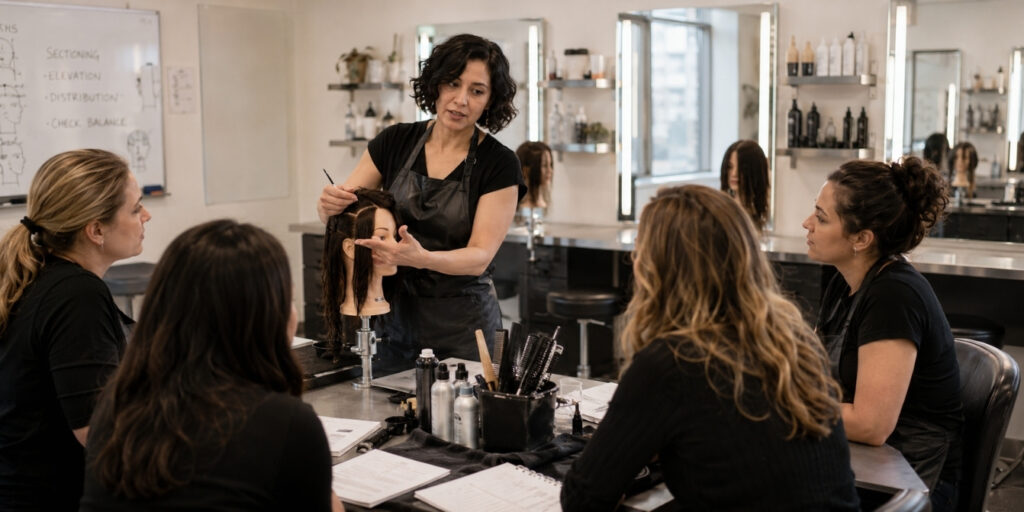
Many seasoned professionals eventually realize that working behind a styling chair, manicure table, or skin treatment bed takes a massive toll on the body. Spending years perfecting chemical mixtures, mastering technical tools, and managing different client personalities builds incredible skill, but it also highlights a structural limit. When physical fatigue sets in, transitioning from daily service work into an educational role becomes a clear path forward for experienced stylists, estheticians, and nail technicians.
However, taking that leap can bring up feelings of doubt. You might feel fully confident performing an intricate skin treatment or a complex color service, yet feel completely unprepared to guide a full classroom of new students.
That uncertainty usually comes from looking at education the wrong way. True instructional work is not just a basic extension of performing a service. Knowing how to execute a technique requires a completely different approach than knowing how to break down and explain that technique to a beginner. Entering a professional beauty instructor school is not about re-testing your practical abilities. Instead, it serves as a development space to turn your hands-on background into structured teaching skills.
Key Takeaways
- Methodology Focus: Training does not repeat basic salon work. The coursework centers on the core principles of lesson design and structured knowledge transfer.
- Classroom Communication: Studies focus heavily on presentation delivery, time management, student assessment, and understanding diverse learning habits to build public speaking confidence.
- Digital Evolution: Programs prepare future educators to manage modern training tools, including learning management platforms and online theory delivery systems where approved.
- Regulatory Standards: Grading requirements and studies emphasize compliance, including state guidelines, hourly tracking, and keeping lessons within legal bounds.
Learning How to Teach, Not How to Style
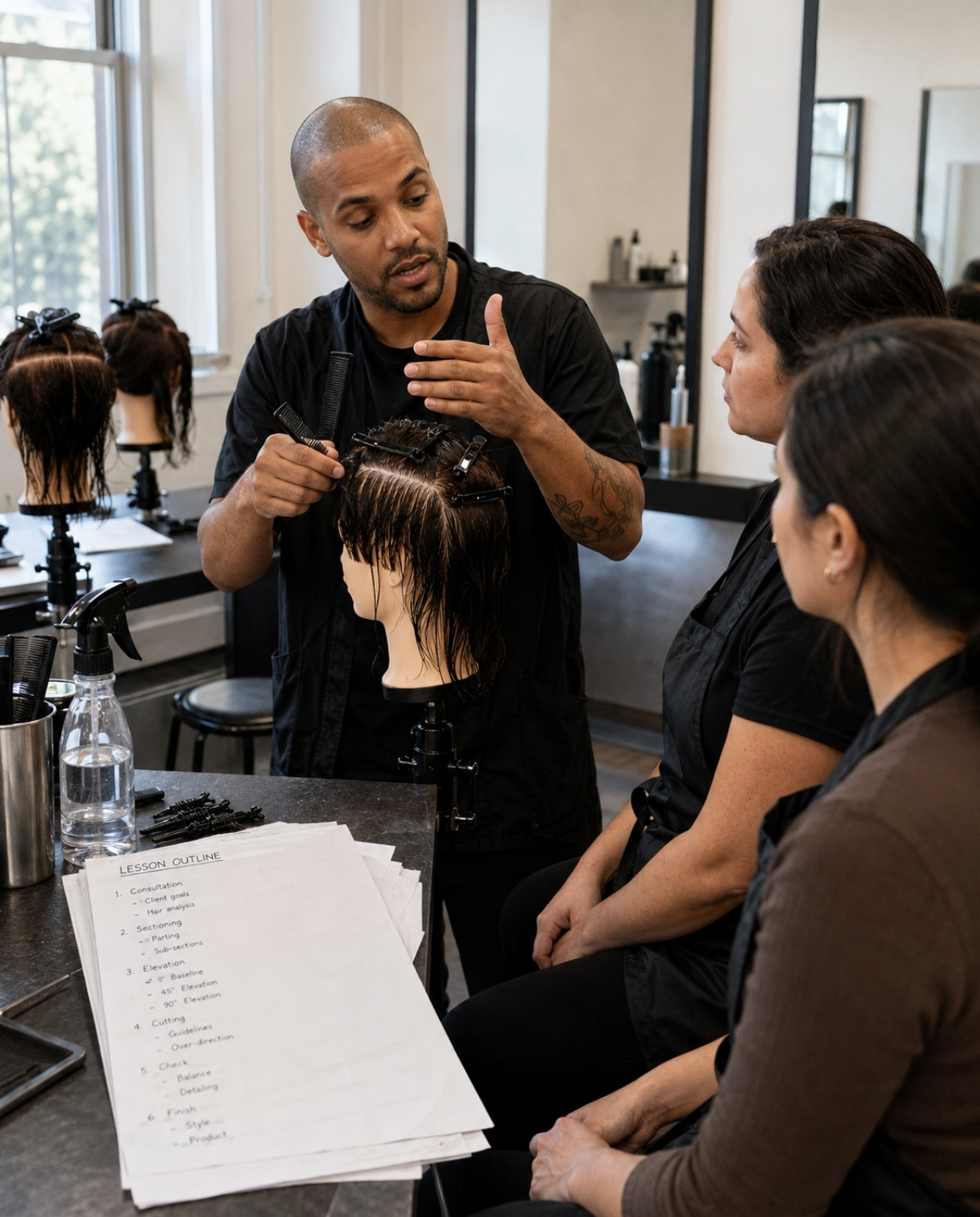
The biggest hesitation beauty professionals face when considering a beauty instructor program is the fear of paying tuition to repeat foundational technical training. However, a state-approved beauty instructor training program relies entirely on your existing field competency. The focus shifts completely toward pedagogy—the actual study of teaching methods and curriculum structure.
When you enter a cosmetology instructor program, the primary goal is learning how to explain choices that you currently make automatically. Experienced professionals rely deeply on muscle memory. You know exactly how much tension to hold on a section of hair, or how much pressure to apply during a deep cleansing facial, but you often do it without planning the words. Specialized beauty school instructor training forces you to analyze those silent habits and translate them into direct, clear verbal guidance.
Instead of guiding a student based on vague feelings, you learn to deliver precise directives that help a beginner understand the physical alignment required for the service.
Through a structured beauty instructor training process, you learn to map out a complete syllabus, organize daily lesson plans, utilize visual aids, grade practical tasks fairly, and connect salon floor assignments directly with formal testing rubrics. This structured preparation helps you master the daily layout of a school, allowing you to transition easily from a structured theory lecture in the morning to supervising a busy clinic floor later in the day. To see how these educational duties fit into a broader professional path, review our guide on what a beauty instructor is, meaning, duties, and career path explained.
The Four-Step Instructional Framework
Legitimate training paths, such as the structures used by the International School of Beauty, Coastal Alabama Community College, and formal educator guidelines, center on practical teaching application. For example, Coastal Alabama's cosmetology instructor training program includes teaching and curriculum development, teacher mentorship, lesson-plan implementation, student assessment, and the four-step teaching method.
The objective is never to make an experienced pro practice basic salon services like an amateur. Your grades depend entirely on your ability to plan a lesson, explain concepts clearly, monitor student practice safely, and judge results objectively. Instead of simply telling a student that a placement is incorrect, you learn to build clear rubrics and performance benchmarks so they understand exactly how to correct their technical errors.
Classroom Management and Adult Learning Psychology
The fear of standing in front of an audience, losing your train of thought, or losing control of classroom order can feel like a major barrier. To prevent this, professional educator courses focus heavily on communication dynamics, student motivation, and adult learning behaviors.
Adult students absorb information differently than younger learners. They are highly practical, goal-oriented, and bring their own personal backgrounds into the classroom. In a beauty training setting, this means your lesson plans cannot remain entirely theoretical. To keep students focused, you must connect theory concepts straight to real-world salon scenarios, such as sanitation protocols, chemical safety, client consultations, state board preparation, and the financial impact of poor execution.
You will learn to identify and balance different learning styles, ensuring your lesson delivery supports visual, auditory, and hands-on learners simultaneously. A student who struggles to retain information from a textbook might grasp the concept immediately when you show a live demonstration, use a visual diagram, or provide direct feedback on a mannequin.
Furthermore, you will learn how to maintain structural control of your classroom. This goes far beyond basic discipline. You learn how to balance varying student skill levels, de-escalate competition among peers, redirect distracted individuals, and keep modern students fully engaged without losing your professional boundaries. Understanding how adult students process and apply feedback helps you guide them smoothly toward graduation. This thorough preparation replaces public speaking nerves with an organized, confident classroom presence.
Navigating the Modern Digital Classroom
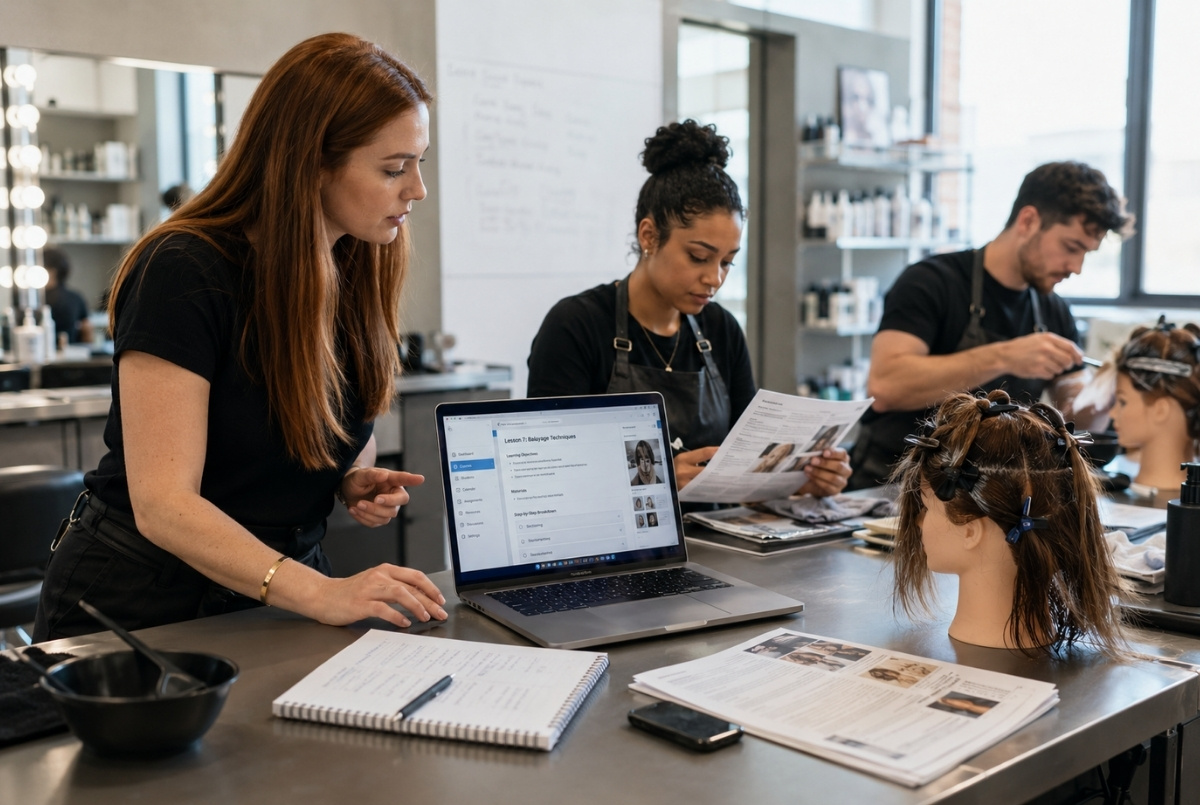
The beauty world regularly adopts new technology, from online salon scheduling platforms to advanced skin analysis applications. Because of this shift, modern beauty instruction has expanded beyond traditional boards and printed packets.
When you enroll in a beauty educator course, your training may introduce you to online gradebooks, hour-tracking software, hybrid lesson delivery, and digital instructional tools. If you choose to look into a cosmetology instructor program online or review options for online classes for cosmetology instructor programs, it is important to understand how they work. Some theory portions may be delivered through distance platforms when approved, but licensure-focused instructor training typically still depends on state-approved requirements, supervised teaching, practical evaluation, and monitored training on a physical school floor.
Your administrative preparation expands from managing a physical classroom to coordinating a digital learning environment. You learn to format lesson content inside learning management software, organize hybrid schedules, track attendance metrics, and use multimedia tools without compromising the physical discipline that hands-on beauty training requires.
You will practice assessing student work through documented records, formatting assignments that bridge online studies with classroom practice, and delivering clear, media-supported lectures. This training aligns directly with the daily operations of modern beauty academies, while opening up additional professional paths in brand education, corporate training support, independent consulting, and curriculum design.
Digital Tools as Learning Aids
Modern classrooms utilize digital learning tools to support the training process, though advanced simulations are best viewed as helpful additions rather than absolute replacements for tactile training. Many instructional frameworks incorporate learning platforms, digital student portfolios, online research materials, and technology overviews, as seen in the guidelines from the ABC Adult School instructional plan. Teacher training options may also implement video communication platforms and digital textbooks like Milady MindTap when distance segments are approved by the proper school or regulatory authority.
For an upcoming instructor, the true talent is not just knowing how to operate software. It is knowing exactly when a digital tool clarifies a concept and when it pulls attention away from safety-sensitive physical practice. A skilled educator uses video previews to introduce a technique and online quizzes to reinforce safety laws, while still requiring monitored practical repetition before a student ever provides services to a guest.
Licensing, Laws, and State Board Demands
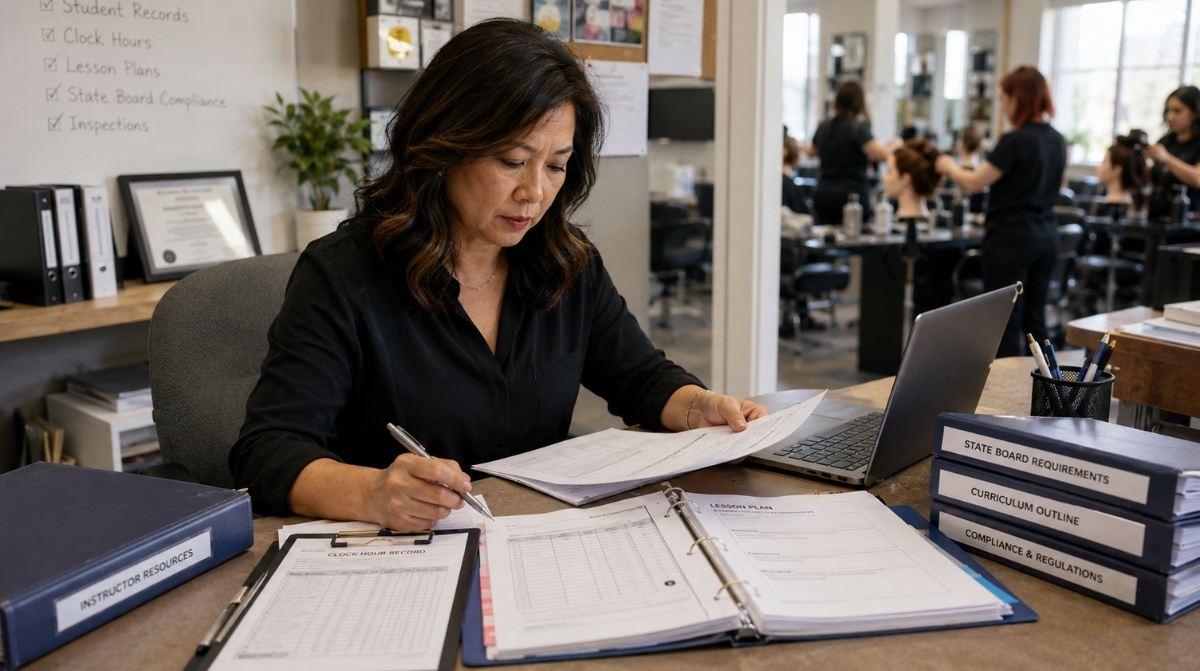
A critical priority for any beauty school is maintaining perfect institutional compliance. A major portion of your educational training involves learning the administrative laws and guidelines that protect a school's license.
Your training focuses heavily on interpreting state regulations regarding scope of practice—the exact legal limits defining what a licensed professional can and cannot do. You learn how to structure mock exams that match state board testing sheets, track student clock hours with absolute accuracy, and keep everyday instruction aligned with testing requirements. If you want a clear view of how these steps fit together from the start, check out our resource on your guide on how to become a beauty instructor and earn a teaching license.
Additionally, administrative requirements change over time to match public health priorities, consumer safety needs, and updated industry trends. Your training teaches you how to break down statutory updates, evaluate their impact on your lessons, adjust lesson materials properly, and keep your school fully compliant.
For instance, regulatory updates from organizations like the Illinois Department of Financial and Professional Regulation (IDFPR) demonstrate how state rules evolve. Recent Illinois updates state that barber and cosmetology curricula must include specified training on different hair types and textures. The same update also adds a one-time abnormal skin growth education requirement for new applicants and renewals after January 1, 2026, with IDFPR initially approving Impact Melanoma's free online “Skinny on Skin” program to help applicants and licensees comply. Mastering this regulatory side of education transforms you from a day-to-day teacher into an essential compliance asset for school management.
Niche Specialization: Tailoring Your Teaching Path
While foundational teaching skills apply to every classroom, your educator training will guide you in applying those tools directly to your chosen field.
Esthetics Instructor Focus
If you choose an esthetics instructor training program path, your coursework focuses on teaching advanced skin analysis, strict sanitation standards, treatment contraindications, product chemistry, and skin histology. You learn how to guide students safely through delicate physical concepts, such as the skin's lipid barrier—the outer protective layer that prevents vital moisture loss—while monitoring hands-on facial steps within legal operational limits.
The true educational goal here is not simply explaining what a specific skincare product does. It is training your students to analyze complex skin conditions, know exactly when a service must be modified or turned down for safety reasons, document skin charts accurately, and maintain the line between cosmetic skin care and medical treatment. Your training helps you teach students to evaluate product labels carefully, shifting their focus from marketing narratives to proven cosmetic science.
Nail Instructor Focus
For professionals focusing on a nail instructor program structure, the educational curriculum highlights workplace ergonomics, chemical safety, infection control, safe electrical file use, and proper product ratios.
In this specialized environment, polymerization—the chemical process where single monomers bond together to form durable acrylic enhancements—is a vital topic. It directly affects ventilation safety, curing times, product durability, and long-term nail plate health. You learn how to teach the precise structure of artificial extensions, apex placement, correct filing angles, and disinfection protocols that safeguard everyone in the salon. The priority is ensuring your future students graduate with stronger ergonomic awareness, excellent safety habits, and full confidence.
Reducing Redundant Training Barriers
The global beauty and cosmetology school market continues to grow significantly, with projections reaching $9.61 billion in 2026 according to data from Business Research Insights. Because of this expansion, training facilities need structured educators who can teach, manage, and adapt smoothly as local rules change. This is why regulatory updates are working to eliminate unnecessary training paths for experienced professionals who want to expand their credentials.
A practical example of this shift is highlighted in recent IDFPR compliance notes. The rules specify that qualified educators may obtain additional instructor licenses without being forced to repeat long, redundant training hours. Instead, they are permitted to focus solely on the specific subject blocks not covered in their original training. For example, a licensed cosmetology instructor looking to add a barber teacher credential might only need to finish the missing shaving and facial hair modules rather than repeating a full crossover program.
These updates are highly beneficial because they recognize existing professional experience while addressing real training gaps. For a seasoned beauty professional, advancing your career is not about starting your education completely over from zero. It is about validating your experience, mastering structural teaching methods, and stepping into the classroom efficiently.
Step Off the Salon Floor and Into Your Authority
Moving from a traditional salon chair, nail station, or skincare clinic into an educational leadership role is an excellent way to elevate your career. It allows you to step away from the daily physical strain of constant service work and establishes you as a true industry leader. To guide a classroom with complete confidence, you simply need an educational foundation that matches your goals.
By combining your practical experience with structured teaching training, you build a lasting career path with excellent professional leverage. You have already proven that you can master the technical work with clients. Now, you can master the structured framework required to teach those skills to others. Do not leave your valuable industry experience locked behind automatic habits. Turn it into a rewarding career that guides the next generation of beauty professionals.
If you are ready to learn more about schedules, class starts, and how to begin your training, you can explore the complete process on our Enrollment Page.
If you have questions about program timelines, formatting, or enrollment details, we are here to help. Just share your contact information in the form below, and our admissions team will reach out directly to help you plan your next professional step.