Beauty Instructor Training: How Salon Pros Learn to Lead the Classroom

Many seasoned professionals eventually realize that working behind a styling chair, manicure table, or skin treatment bed takes a massive toll on the body. Spending years perfecting chemical mixtures, mastering technical tools, and managing different client personalities builds incredible skill, but it also highlights a structural limit. When physical fatigue sets in, transitioning from daily service work into an educational role becomes a clear path forward for experienced stylists, estheticians, and nail technicians.

However, taking that leap can bring up feelings of doubt. You might feel fully confident performing an intricate skin treatment or a complex color service, yet feel completely unprepared to guide a full classroom of new students.

That uncertainty usually comes from looking at education the wrong way. True instructional work is not just a basic extension of performing a service. Knowing how to execute a technique requires a completely different approach than knowing how to break down and explain that technique to a beginner. Entering a professional beauty instructor school is not about re-testing your practical abilities. Instead, it serves as a development space to turn your hands-on background into structured teaching skills.

Key Takeaways

  • Methodology Focus: Training does not repeat basic salon work. The coursework centers on the core principles of lesson design and structured knowledge transfer.
  • Classroom Communication: Studies focus heavily on presentation delivery, time management, student assessment, and understanding diverse learning habits to build public speaking confidence.
  • Digital Evolution: Programs prepare future educators to manage modern training tools, including learning management platforms and online theory delivery systems where approved.
  • Regulatory Standards: Grading requirements and studies emphasize compliance, including state guidelines, hourly tracking, and keeping lessons within legal bounds.

Learning How to Teach, Not How to Style
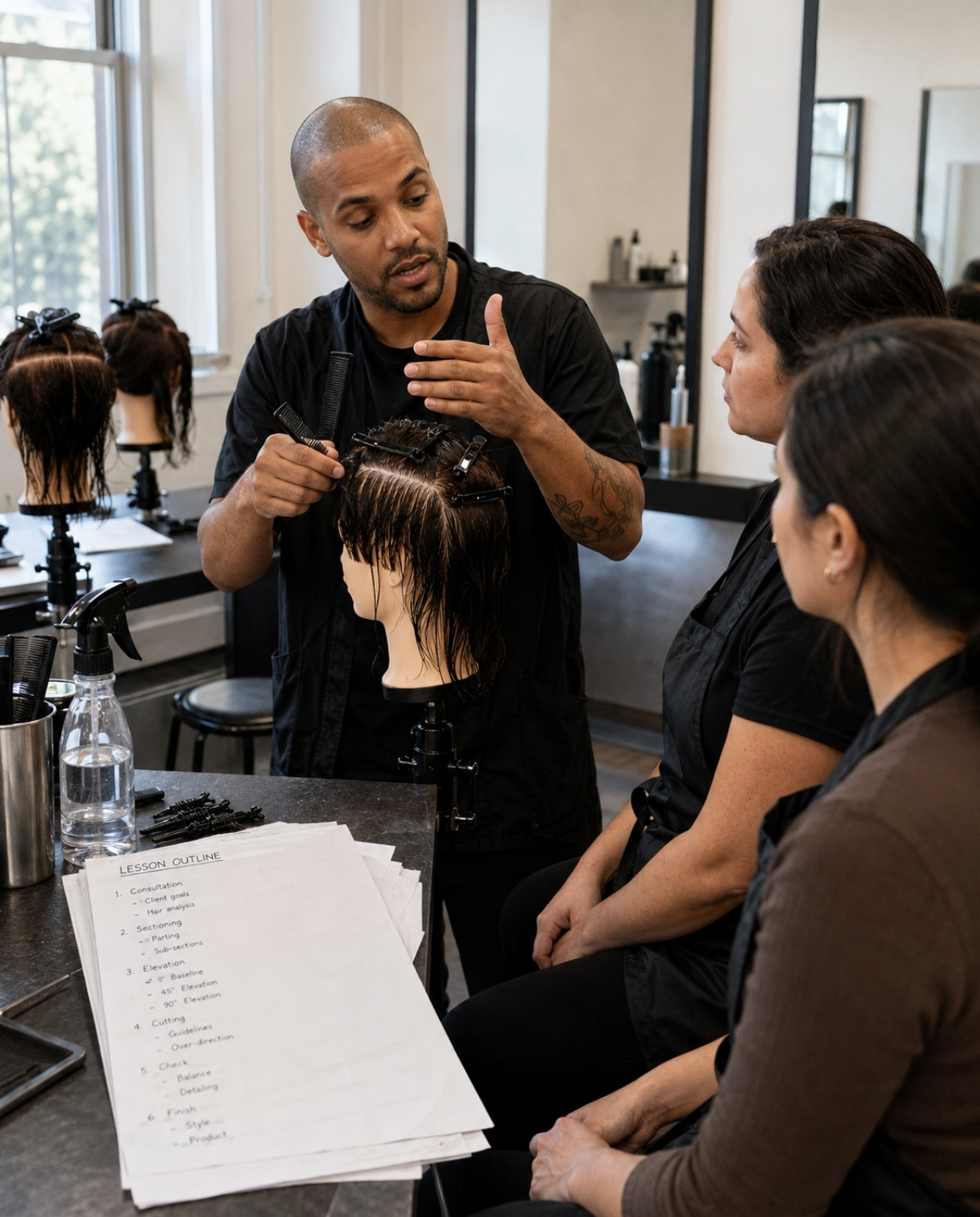
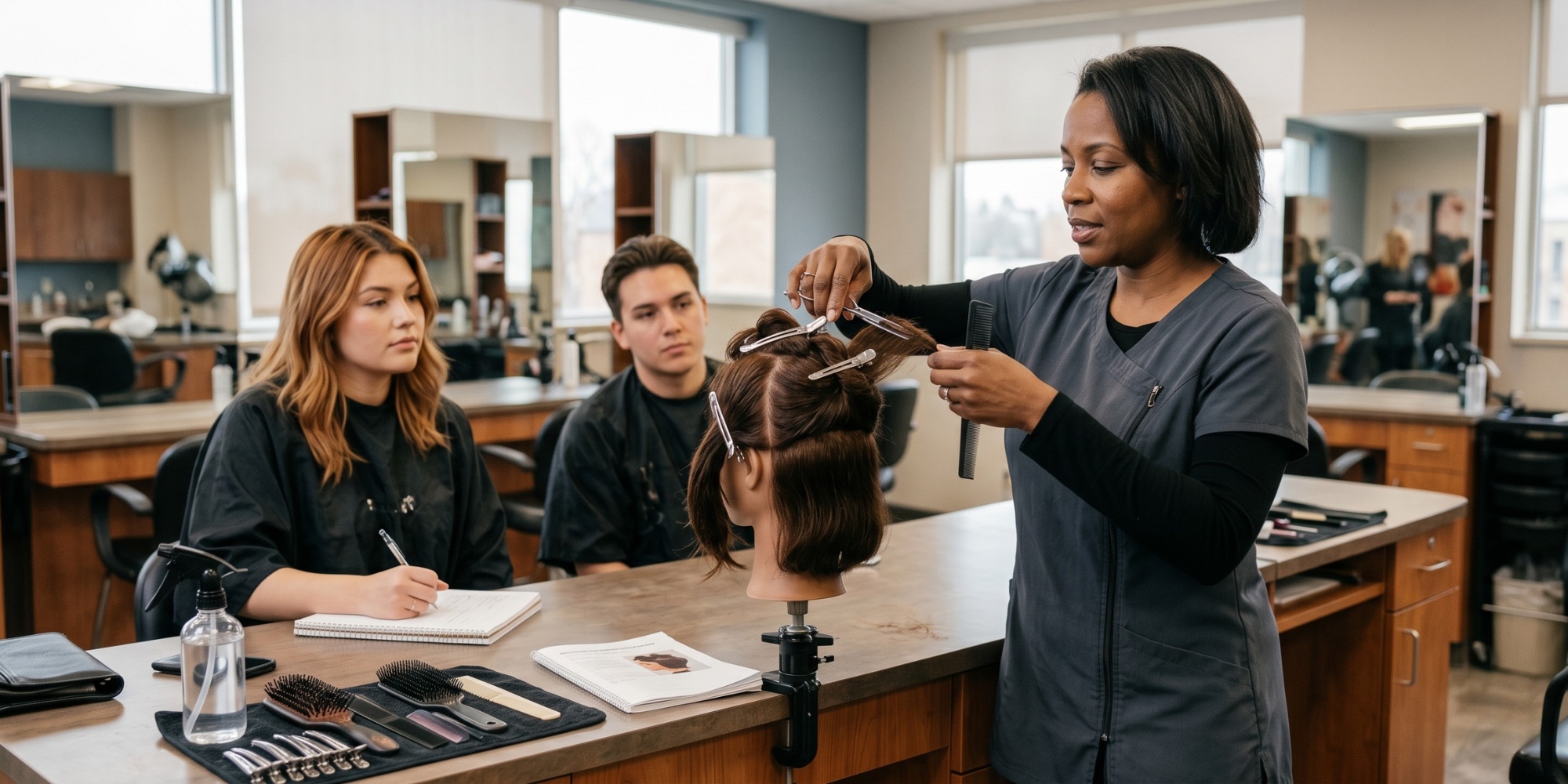
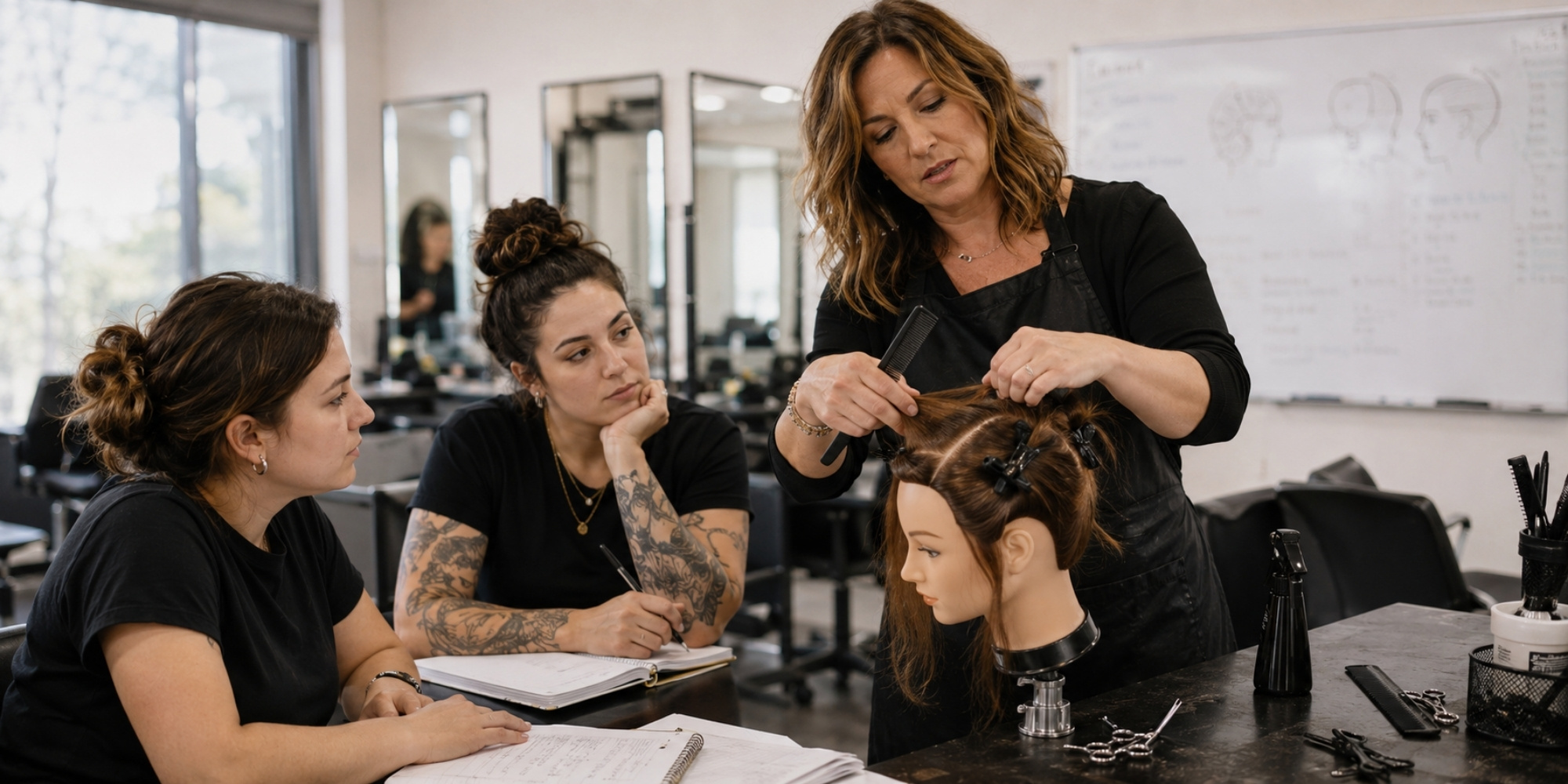
Male beauty instructor explaining hair sectioning on a mannequin head while two adult students observe closely during hands-on classroom training.

The biggest hesitation beauty professionals face when considering a beauty instructor program is the fear of paying tuition to repeat foundational technical training. However, a state-approved beauty instructor training program relies entirely on your existing field competency. The focus shifts completely toward pedagogy—the actual study of teaching methods and curriculum structure.

When you enter a cosmetology instructor program, the primary goal is learning how to explain choices that you currently make automatically. Experienced professionals rely deeply on muscle memory. You know exactly how much tension to hold on a section of hair, or how much pressure to apply during a deep cleansing facial, but you often do it without planning the words. Specialized beauty school instructor training forces you to analyze those silent habits and translate them into direct, clear verbal guidance.

Instead of guiding a student based on vague feelings, you learn to deliver precise directives that help a beginner understand the physical alignment required for the service.

Through a structured beauty instructor training process, you learn to map out a complete syllabus, organize daily lesson plans, utilize visual aids, grade practical tasks fairly, and connect salon floor assignments directly with formal testing rubrics. This structured preparation helps you master the daily layout of a school, allowing you to transition easily from a structured theory lecture in the morning to supervising a busy clinic floor later in the day. To see how these educational duties fit into a broader professional path, review our guide on what a beauty instructor is, meaning, duties, and career path explained.

The Four-Step Instructional Framework

Legitimate training paths, such as the structures used by the International School of Beauty, Coastal Alabama Community College, and formal educator guidelines, center on practical teaching application. For example, Coastal Alabama’s cosmetology instructor training program includes teaching and curriculum development, teacher mentorship, lesson-plan implementation, student assessment, and the four-step teaching method.

The objective is never to make an experienced pro practice basic salon services like an amateur. Your grades depend entirely on your ability to plan a lesson, explain concepts clearly, monitor student practice safely, and judge results objectively. Instead of simply telling a student that a placement is incorrect, you learn to build clear rubrics and performance benchmarks so they understand exactly how to correct their technical errors.

Classroom Management and Adult Learning Psychology

The fear of standing in front of an audience, losing your train of thought, or losing control of classroom order can feel like a major barrier. To prevent this, professional educator courses focus heavily on communication dynamics, student motivation, and adult learning behaviors.

Adult students absorb information differently than younger learners. They are highly practical, goal-oriented, and bring their own personal backgrounds into the classroom. In a beauty training setting, this means your lesson plans cannot remain entirely theoretical. To keep students focused, you must connect theory concepts straight to real-world salon scenarios, such as sanitation protocols, chemical safety, client consultations, state board preparation, and the financial impact of poor execution.

You will learn to identify and balance different learning styles, ensuring your lesson delivery supports visual, auditory, and hands-on learners simultaneously. A student who struggles to retain information from a textbook might grasp the concept immediately when you show a live demonstration, use a visual diagram, or provide direct feedback on a mannequin.

Furthermore, you will learn how to maintain structural control of your classroom. This goes far beyond basic discipline. You learn how to balance varying student skill levels, de-escalate competition among peers, redirect distracted individuals, and keep modern students fully engaged without losing your professional boundaries. Understanding how adult students process and apply feedback helps you guide them smoothly toward graduation. This thorough preparation replaces public speaking nerves with an organized, confident classroom presence.

Navigating the Modern Digital Classroom

Beauty instructor using a laptop lesson platform while students review printed materials and practice on mannequin heads in a modern cosmetology classroom.

The beauty world regularly adopts new technology, from online salon scheduling platforms to advanced skin analysis applications. Because of this shift, modern beauty instruction has expanded beyond traditional boards and printed packets.

When you enroll in a beauty educator course, your training may introduce you to online gradebooks, hour-tracking software, hybrid lesson delivery, and digital instructional tools. If you choose to look into a cosmetology instructor program online or review options for online classes for cosmetology instructor programs, it is important to understand how they work. Some theory portions may be delivered through distance platforms when approved, but licensure-focused instructor training typically still depends on state-approved requirements, supervised teaching, practical evaluation, and monitored training on a physical school floor.

Your administrative preparation expands from managing a physical classroom to coordinating a digital learning environment. You learn to format lesson content inside learning management software, organize hybrid schedules, track attendance metrics, and use multimedia tools without compromising the physical discipline that hands-on beauty training requires.

You will practice assessing student work through documented records, formatting assignments that bridge online studies with classroom practice, and delivering clear, media-supported lectures. This training aligns directly with the daily operations of modern beauty academies, while opening up additional professional paths in brand education, corporate training support, independent consulting, and curriculum design.

Digital Tools as Learning Aids

Modern classrooms utilize digital learning tools to support the training process, though advanced simulations are best viewed as helpful additions rather than absolute replacements for tactile training. Many instructional frameworks incorporate learning platforms, digital student portfolios, online research materials, and technology overviews, as seen in the guidelines from the ABC Adult School instructional plan. Teacher training options may also implement video communication platforms and digital textbooks like Milady MindTap when distance segments are approved by the proper school or regulatory authority.

For an upcoming instructor, the true talent is not just knowing how to operate software. It is knowing exactly when a digital tool clarifies a concept and when it pulls attention away from safety-sensitive physical practice. A skilled educator uses video previews to introduce a technique and online quizzes to reinforce safety laws, while still requiring monitored practical repetition before a student ever provides services to a guest.

Licensing, Laws, and State Board Demands

Beauty school training coordinator reviewing student records, clock hour forms, lesson plans, and compliance binders in an office beside a working classroom.

A critical priority for any beauty school is maintaining perfect institutional compliance. A major portion of your educational training involves learning the administrative laws and guidelines that protect a school’s license.

Your training focuses heavily on interpreting state regulations regarding scope of practice—the exact legal limits defining what a licensed professional can and cannot do. You learn how to structure mock exams that match state board testing sheets, track student clock hours with absolute accuracy, and keep everyday instruction aligned with testing requirements. If you want a clear view of how these steps fit together from the start, check out our resource on your guide on how to become a beauty instructor and earn a teaching license.

Additionally, administrative requirements change over time to match public health priorities, consumer safety needs, and updated industry trends. Your training teaches you how to break down statutory updates, evaluate their impact on your lessons, adjust lesson materials properly, and keep your school fully compliant.

For instance, regulatory updates from organizations like the Illinois Department of Financial and Professional Regulation (IDFPR) demonstrate how state rules evolve. Recent Illinois updates state that barber and cosmetology curricula must include specified training on different hair types and textures. The same update also adds a one-time abnormal skin growth education requirement for new applicants and renewals after January 1, 2026, with IDFPR initially approving Impact Melanoma’s free online “Skinny on Skin” program to help applicants and licensees comply. Mastering this regulatory side of education transforms you from a day-to-day teacher into an essential compliance asset for school management.

Niche Specialization: Tailoring Your Teaching Path

While foundational teaching skills apply to every classroom, your educator training will guide you in applying those tools directly to your chosen field.

Esthetics Instructor Focus

If you choose an esthetics instructor training program path, your coursework focuses on teaching advanced skin analysis, strict sanitation standards, treatment contraindications, product chemistry, and skin histology. You learn how to guide students safely through delicate physical concepts, such as the skin’s lipid barrier—the outer protective layer that prevents vital moisture loss—while monitoring hands-on facial steps within legal operational limits.

The true educational goal here is not simply explaining what a specific skincare product does. It is training your students to analyze complex skin conditions, know exactly when a service must be modified or turned down for safety reasons, document skin charts accurately, and maintain the line between cosmetic skin care and medical treatment. Your training helps you teach students to evaluate product labels carefully, shifting their focus from marketing narratives to proven cosmetic science.

Nail Instructor Focus

For professionals focusing on a nail instructor program structure, the educational curriculum highlights workplace ergonomics, chemical safety, infection control, safe electrical file use, and proper product ratios.

In this specialized environment, polymerization—the chemical process where single monomers bond together to form durable acrylic enhancements—is a vital topic. It directly affects ventilation safety, curing times, product durability, and long-term nail plate health. You learn how to teach the precise structure of artificial extensions, apex placement, correct filing angles, and disinfection protocols that safeguard everyone in the salon. The priority is ensuring your future students graduate with stronger ergonomic awareness, excellent safety habits, and full confidence.

Reducing Redundant Training Barriers

The global beauty and cosmetology school market continues to grow significantly, with projections reaching $9.61 billion in 2026 according to data from Business Research Insights. Because of this expansion, training facilities need structured educators who can teach, manage, and adapt smoothly as local rules change. This is why regulatory updates are working to eliminate unnecessary training paths for experienced professionals who want to expand their credentials.

A practical example of this shift is highlighted in recent IDFPR compliance notes. The rules specify that qualified educators may obtain additional instructor licenses without being forced to repeat long, redundant training hours. Instead, they are permitted to focus solely on the specific subject blocks not covered in their original training. For example, a licensed cosmetology instructor looking to add a barber teacher credential might only need to finish the missing shaving and facial hair modules rather than repeating a full crossover program.

These updates are highly beneficial because they recognize existing professional experience while addressing real training gaps. For a seasoned beauty professional, advancing your career is not about starting your education completely over from zero. It is about validating your experience, mastering structural teaching methods, and stepping into the classroom efficiently.

Step Off the Salon Floor and Into Your Authority

Moving from a traditional salon chair, nail station, or skincare clinic into an educational leadership role is an excellent way to elevate your career. It allows you to step away from the daily physical strain of constant service work and establishes you as a true industry leader. To guide a classroom with complete confidence, you simply need an educational foundation that matches your goals.

By combining your practical experience with structured teaching training, you build a lasting career path with excellent professional leverage. You have already proven that you can master the technical work with clients. Now, you can master the structured framework required to teach those skills to others. Do not leave your valuable industry experience locked behind automatic habits. Turn it into a rewarding career that guides the next generation of beauty professionals.

If you are ready to learn more about schedules, class starts, and how to begin your training, you can explore the complete process on our Enrollment Page.

If you have questions about program timelines, formatting, or enrollment details, we are here to help. Just share your contact information in the form below, and our admissions team will reach out directly to help you plan your next professional step.
Your Guide on How to Become a Beauty Instructor and Earn a Teaching License

Standing behind a salon chair for long hours day after day eventually takes a heavy toll on the human body. Most stylists absolutely love the creative craft and the fulfillment of transforming clients, but persistent lower back pain, throbbing wrists, and the financial stress of unpredictable commissions or sudden booth rental spikes often force a tough conversation about the future. Moving into an educational career is not about walking away from that hard-earned passion, but rather graduating to the next level of it. Stepping into a classroom shifts a daily routine from constant physical service work to intellectual authority, structured mentorship, and professional leadership. It is an effective way to preserve physical longevity, build a more predictable career path, strengthen professional credibility, and directly shape the upcoming generation of talent.

If you are ready to pivot your years of salon experience into a sustainable, structured career, here is the realistic blueprint for navigating the regulatory pathways to become a qualified teacher in the industry.

Key Takeaways

  • Physical & Career Longevity: Moving from full-time floor styling into education can extend your career life by shifting much of your daily routine from repetitive manual service work to classroom leadership, student coaching, and curriculum delivery.
  • Predictable Financial Growth: Transitioning to a beauty school instructor role can provide a more stable income floor, helping reduce the weekly income spikes and drops that often come with salon booking commission or booth rentals.
  • State-Driven Rules: Licensing requirements are deeply regional. Some states require instructor training hours and state exams, while others have restructured or even eliminated separate instructor licensing. Always confirm your pathway with your state board before enrolling.
  • The Hybrid Advantage: Some modern programs may let you complete theory-based coursework online or in a hybrid format, but state approval, supervised teaching, documented work experience, hands-on requirements, and each school’s delivery format still depend on your state and institution.

Decoding the Roles – Beauty Instructors

Before committing to state board paperwork, you need to understand the structural differences between institutional teaching and private coaching. These terms are frequently blended online, but their legal authority, daily environments, and compliance responsibilities are not always the same.

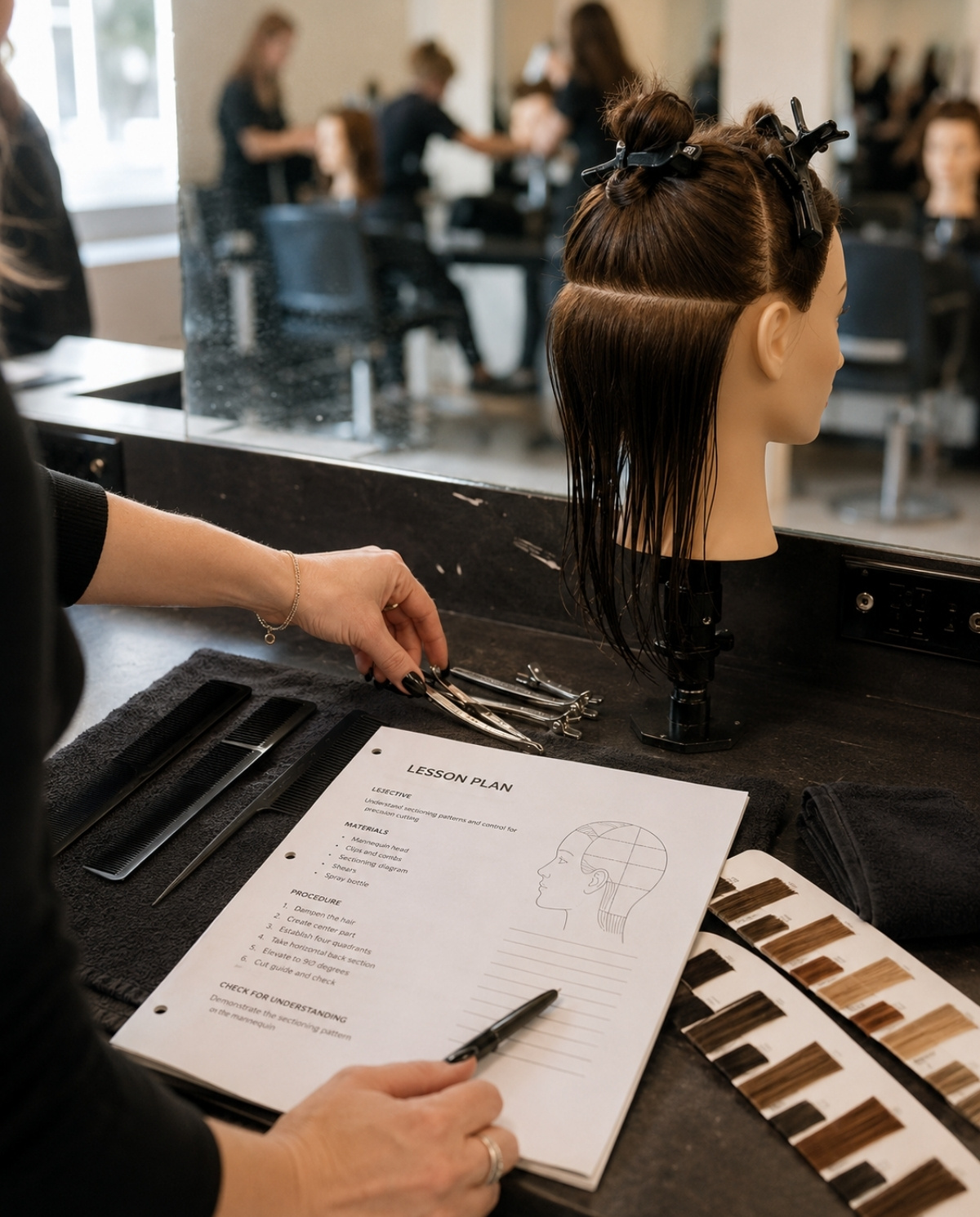
Mannequin head, lesson plan, combs, clips, and color swatches on a beauty training workstation.

Defining the Culture

Entering this field means becoming a true beauty culture instructor. To define beauty culture instructor roles clearly, you need to look beyond technical skill and focus on what the position protects: sanitation habits, chemical safety, client-care standards, professional behavior, and the legal structure that keeps a salon or school compliant. You aren’t just showing a student how to execute a trendy haircut; you are molding their technical discipline from the ground up.

Since the meaning, duties, and career paths are already explained in depth in our dedicated guide on what is a beauty instructor, this article focuses more specifically on the pathway: how to move from licensed beauty professional to qualified instructor.

The Institutional Track

Inside an accredited academy, a beauty school instructor is an institutional anchor. What is a cosmetology instructor required to do daily? Your responsibilities extend far beyond technical demonstrations. Essentially, you are tasked with preparing compliant lesson plans, delivering structured school curriculum, grading theoretical exams, coaching students through skill development, and managing the busy logistics of the student clinic floor.

To step into this role legally, you must follow the rules of the state where you plan to teach. In many states, that means completing an approved beauty school instructor training framework and passing a formal instructor exam. In other states, the pathway may depend more heavily on your active professional license, verified work experience, employer requirements, or school-level qualifications. Either way, it is a regulated teaching environment where you guide students through mandatory clock hours while maintaining strict compliance with state board guidelines.

The Independent Track

On the other side of the industry is the independent beauty educator. A private educator of beauty typically operates outside the traditional academy ecosystem. These professionals design their own specialized training courses, host private advanced masterclasses, or issue private beauty educator diplomas to licensed professionals seeking niche expertise.

While an online beauty educator focuses heavily on digital brand building, virtual mentorship, and remote business training, they are still tied to the industry’s educational quality. Many independent educators choose to enroll in formal beauty educator training courses to master adult learning theory, presentation skills, and curriculum structure, even when their work does not require a state-issued instructor license.

Niche Specializations

Depending on your foundational license, your teacher training will focus on a specific branch of the industry:

  • The Hair Specialist: If you want to teach cutting, coloring, and styling, you will focus on becoming a hair stylist instructor or a comprehensive hair and beauty instructor. For those specializing in natural textures, locs, and protective styles, a natural hair care instructor pathway can be especially valuable in states that recognize natural hair care as a separate license category or teaching area.
  • The Skin Specialist: If your focus is clinical skincare, you will step into the role of an esthetics instructor. A common question arises: Can a cosmetology instructor teach esthetics? The answer depends entirely on your state board’s scope of practice – the legal boundaries governing your license. In some states, a cosmetology instructor may be able to teach basic skin concepts if those subjects fall within the original cosmetology curriculum. However, advanced esthetics, chemical exfoliation, or clinical-grade skin services may require a dedicated esthetics instructor credential or an esthetics-specific teaching qualification.
  • The Nail Specialist: If your expertise lies in nail enhancements and structural design, you will fulfill the duties of a nail tech instructor. Becoming a nail master instructor may involve completing a specialized nail instructor program, depending on your state, and your training will usually balance modern nail design with chemical safety, sanitation, infection control, and nail anatomy.

The Financial & Career Longevity Reality

  • The Data: Current earnings metrics published by ZipRecruiter report that the national average salary for a beauty educator is $55,852 annually, with most salaries falling between approximately $36,000 and $63,000 and top earners around $75,000. The same source lists outlier salaries above that range, but those higher figures may reflect specialized brand education, management, independent course sales, or nontraditional educator roles. In contrast, the U.S. Bureau of Labor Statistics Occupational Outlook reports that hairdressers, hairstylists, and cosmetologists earned a median wage of $16.95 per hour in May 2024, or roughly $35,250 annually when converted to full-time work.
  • The Takeaway: Moving into education can provide a more predictable professional track than relying only on salon booking volume, commission swings, or booth-rental economics. More importantly, it transitions your expertise from manual service work into mentorship, which can help you build a longer, more sustainable career.

State Licensing and Hour Requirements

The most significant hurdle for prospective teachers is dealing with state bureaucracy. You cannot assume that years behind the chair automatically authorize you to run a classroom. In many states, you must earn a formal beauty school instructor license or meet a documented instructor qualification pathway before teaching inside a licensed school.

Cosmetology instructor study notes, checklist, calendar, highlighters, and mannequin head on a desk.

Breaking Down the Hours

To qualify for an instructor credential, many state boards require documented training hours, approved education, verified work experience, or some combination of these requirements. There are two common pathways to meet those standards:

  • The Academy Path: You enroll directly in an instructor training program at an approved beauty school. Here, you complete a structured curriculum focused on educational psychology, lesson planning, test construction, classroom management, and supervised teaching.
  • The Apprenticeship or Experience Path: Some states offer an instructor apprenticeship, on-the-job instructor training, or work-experience alternative. Instead of completing only a traditional school program, you may qualify by documenting professional experience under the rules set by your state board.

A Snapshot of State-Specific Rules

Because beauty laws are hyper-local, requirements vary sharply by region:

  • Texas & Florida: Texas is a special case because the state eliminated separate barber and cosmetology instructor licenses. According to the Texas Department of Licensing and Regulation, licensed schools may hire teachers without requiring a separate instructor license, though schools still need to follow state school rules and hiring standards. Florida is also different from many states because the Florida DBPR cosmetology licensing structure does not appear to list a separate cosmetology instructor license in the same way states like Georgia or North Carolina do. In both states, applicants should confirm school-level hiring requirements before assuming a private educator diploma is enough.
  • Ohio & Georgia: Earning an Ohio cosmetology instructor license requires following the pathway set by the Ohio State Cosmetology and Barber Board, including the current requirements for instructor applicants in that state. In Georgia, the pathway is more directly relevant for local students: the Georgia Secretary of State requires cosmetology instructor applicants to meet application requirements, hold the appropriate Georgia master-level license, document work experience, and pass the required instructor examinations.
  • Utah & North Carolina: North Carolina requires teacher applicants to complete an approved teacher program or meet a qualifying work-experience pathway. The North Carolina Board of Cosmetic Art Examiners lists 800 hours for cosmetologist teachers, 320 hours for manicurist teachers, 320 hours for natural hair care teachers, or 650 hours for esthetician teachers, with an alternative pathway based on full-time work experience. Utah is also specific: the Utah Department of Commerce states that instructor applicants must pass the Utah Instructor’s Theory examination and qualify under the applicable instructor license pathway for their trade.

Can You Complete Your Instructor Training Online?

Because you are likely working full-time to pay your bills, finding a flexible schedule is crucial. This makes the option of an online beauty educator course highly appealing.

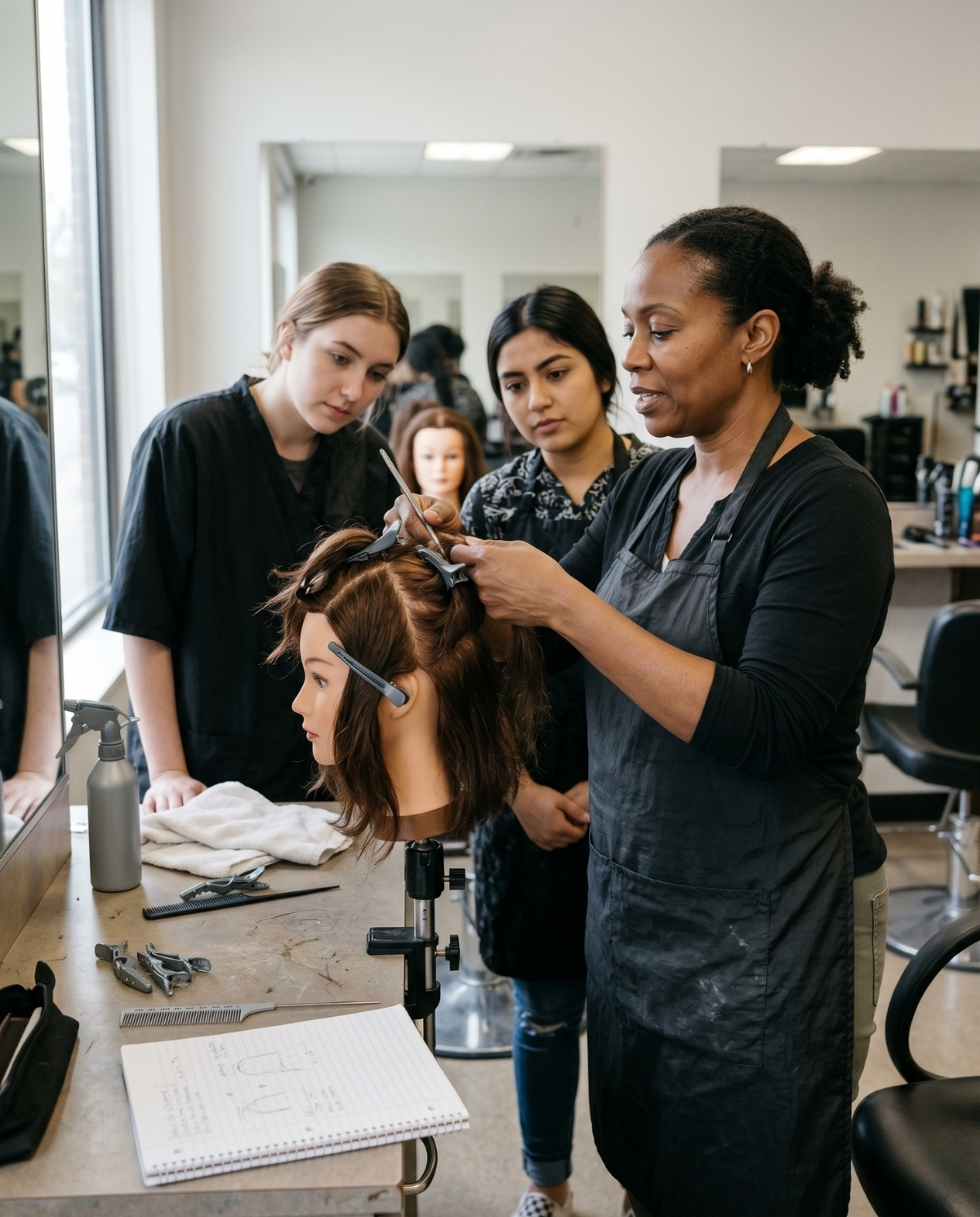
Beauty instructor supervising students during hands-on hair practice in a training classroom.

The Reality of Hybrid Learning

Can you get your instructor license online? The honest answer is: sometimes part of the process may be online, but the full answer depends on your state, school, and approved program format. A cosmetology instructor course online or an online esthetics instructor course may allow you to complete theory-based topics from home, including cognitive learning styles, lesson planning mechanics, student grading ethics, and classroom management strategies.

However, online convenience does not automatically equal licensure approval, and not every approved beauty school offers distance education for instructor training. Before enrolling, confirm that the school is approved by your state board, that the course hours will count toward the instructor credential or qualification pathway you actually need, and that the delivery format matches the school’s current catalog and state approval.

What Must Be Hands-On

You cannot fully learn how to de-escalate a conflict on a busy student salon floor or judge a haircut angle through a webcam alone. Many state-approved programs still require supervised teaching, in-person clinic-floor experience, or documented work experience before you can qualify. During this phase, you may step into a physical beauty school to deliver live lessons, observe student performance, and supervise real clinic floor operations under the evaluation of an experienced instructor.

The Myth of “Free” Programs

Be highly skeptical of online advertisements offering free online instructor training in the USA. Free study guides, webinars, and video overviews can help you prepare, but they usually do not replace a state-approved instructor program, approved apprenticeship, or documented qualifying experience.

True professional credibility requires more than a downloaded certificate. Selecting a reputable beauty school helps ensure your hours are recognized, your training matches state expectations, and your preparation connects directly to institutional teaching opportunities.

The Tech-Driven Classroom

  • The Data: Recent beauty-school and industry trend coverage from The COLLECTIV Academy and Rizzieri Aveda School points to growing interest in technology, personalization, AR try-on tools, scalp health, skin barrier awareness, and more consultative beauty services. These trends do not replace state-board fundamentals, but they do show why modern instructors need to feel comfortable teaching both classic technical standards and the newer client expectations shaping salons.
  • The Takeaway: Choosing a beauty school that understands modern tools, consultation habits, and updated industry expectations is critical. If you train at an academy using outdated methods, you may not be fully prepared to manage a modern classroom or teach the scientific, client-centered consulting skills that today’s salons increasingly demand.

Conquering the State Board Instructor Exam

It is completely normal to experience a wave of imposter syndrome when facing exams again. You might be a master of medical esthetics or a seasoned hair colorist, but testing on how to teach requires an entirely different psychological approach.

The Structure of the Test

The state board instructor exam is not identical in every state, so always verify the exact format with your licensing agency or approved school. In many states, instructor evaluation may include one or both of the following areas:

  • The Written Theory Exam: This test may assess your knowledge of educational psychology, classroom safety, liability management, sanitation instruction, lesson planning, and performance rubrics. You may be tested on how to accommodate different learning speeds and how to structure fair grading criteria.
  • The Practical or Teaching Evaluation: In states that require a practical or teaching demonstration, you may need to deliver a live or simulated lesson. Examiners may grade your vocal projection, visual aids, safety demonstrations, lesson structure, and ability to break down a technical movement in a clear, teachable way.

Preparation Strategy

To pass on your first attempt, treat your preparation with the same discipline you gave your initial practitioner training. Utilize a specialized cosmetology instructor study guide, review your state board’s official candidate information, and take timed practice exams when available. Focus heavily on localized materials – such as a Utah cosmetology instructor practice test or Ohio cosmetology instructor license study materials – because each state may phrase rules, safety standards, and teaching expectations differently.

Conclusion: Your Next Steps

Transitioning from a salon stylist to a qualified beauty instructor is one of the strongest ways to future-proof your career. It allows you to step away from the constant physical strain of the chair while increasing your professional authority and building a more stable long-term path.

Your long-term success in this new phase depends entirely on the quality of your foundation. Enrolling in a comprehensive, state-approved instructor program at a respected beauty academy helps ensure that you don’t just study to pass a test – you learn how to command a classroom with true confidence.

If you are ready to stop burning out your body and start building your professional legacy, take action today to map out your educator pathway.

Ready to Step into Your Legacy?

We have looked at the hours, the licenses, and the state boards, but the real question isn’t just how to become an instructor – it’s where you want to build your legacy. Choosing the right institution to anchor your training changes your long-term trajectory from day one. You need a platform that understands both the fundamentals of state-board preparation and the direction modern beauty education is heading.

Perimeter Beauty & Barber Institute helps prepare experienced professionals for an educator mindset. The specialized instructor courses focus heavily on developing the pedagogical skills required to lead modern classes successfully. Through structured training in lesson planning, teaching methodologies, classroom management, curriculum creation, instruction delivery, discipline, business management, and state board exam preparation, you can turn your salon wisdom into a professional teaching foundation.

This isn’t about simply going back to school; it is an invitation to join a legacy of beauty education and professional growth. Developing the confidence to move into stronger leadership roles allows passionate stylists, estheticians, nail artists, and beauty professionals to step away from physical burnout and elevate their professional credibility.

Let’s Build the Next Generation Together

Don’t spend another exhausting day wishing for a sustainable schedule and predictable financial security. Take the definitive step toward your future right now.

To begin this transition, you can find out more in Enrollment to see how to align your goals with the school’s current scheduling setup. Additionally, please feel free to fill out the brief contact form we leave right below at the end of the article to connect directly with the admissions team, so we can sit down and help map out a practical path that honors your busy salon schedule.

Frequently Asked Questions

What is the fee to renew a cosmetology instructor license?

Renewal fees vary by state, license type, and renewal cycle, so there is no single national fee. Some states also require continuing education before renewal. For example, Georgia’s board explains its continuing education expectations through the Georgia State Board of Cosmetology and Barbers continuing education requirements. Always check your own state board’s current fee schedule before your renewal deadline.

What is the difference between a beauty educator diploma and a state license?

A beauty educator diploma or certificate is usually awarded by a private brand, product manufacturer, advanced academy, or non-state training provider. It may prove that you have mastered a specialized method or product system. A state-issued instructor license, where required, is a legal credential granted by a state government board that authorizes you to teach approved curriculum inside a licensed beauty school.

Can I use my cosmetology instructor license across different states, or do I need to retest?

This depends entirely on licensure reciprocity or endorsement rules between state boards. If you move from a state with lower hour requirements, different exams, or no separate instructor license into a state with stricter rules, you may need to complete additional hours, submit work-experience proof, pass a state law exam, or apply for a new credential before your license is recognized.

What should I include on a beauty instructor resume if I have never taught before?

If you lack formal classroom experience, emphasize your informal leadership history. Detail your experience training salon assistants, mentoring junior stylists, managing salon inventory and sanitation protocols, leading product knowledge meetings, or helping coworkers improve their technique. These points demonstrate your communication ability, organization, professionalism, and readiness for an educator role.

What Is A Beauty Instructor? Meaning, Duties, And Career Path, All Explained

There comes a time in every stylist’s life when the body begins to signal that twenty years behind a chair might not be the long-term plan. I have seen many incredibly talented professionals reach this point. They still love the industry but need a career path that offers more stability and less physical wear. Moving into the classroom is a way to turn years of technical skill into a legacy. I want to explain the actual beauty instructor meaning and show you how to move into this rewarding role.

Key Takeaways

  • Market Expansion: The global cosmetology and beauty schools market is expected to reach $9.61 billion by 2026, showing that beauty education remains a sizable market.
  • Reliable Income: Data from the U.S. Bureau of Labor Statistics shows that postsecondary career and technical education teachers earn a median salary of about $61,490.
  • Academic Shifts: Modern instruction now focuses heavily on ingredient science, client care, and pedagogy, which is the formal study of how people learn.
  • Career Longevity: Moving into education allows you to stay in the industry you love while reducing the physical strain on your back and hands.

Defining the Modern Beauty Educator

The role of a beauty educator is about much more than just showing a student how to hold a pair of shears. You are essentially the person who builds the foundation for someone else’s career. When I define beauty culture instructor today, I am talking about a licensed professional who has mastered their technical skills and learned how to teach them to others.

The industry uses a few different names for this role. Whether you call yourself a beauty school educator, a hair and beauty educator, or a cosmetology instructor, the goal is to break down complex movements into steps that a beginner can master.

Current trends from HOTT Beauty Lounge highlight a move toward “Clean-ical” beauty, which combines clean ingredients with clinical results. For those in education, this means you will spend more time teaching students about the lipid barrier—the protective layer on the skin—and how products interact with it. You are stepping into a mentorship role in a market that is increasingly focused on wellness and science.

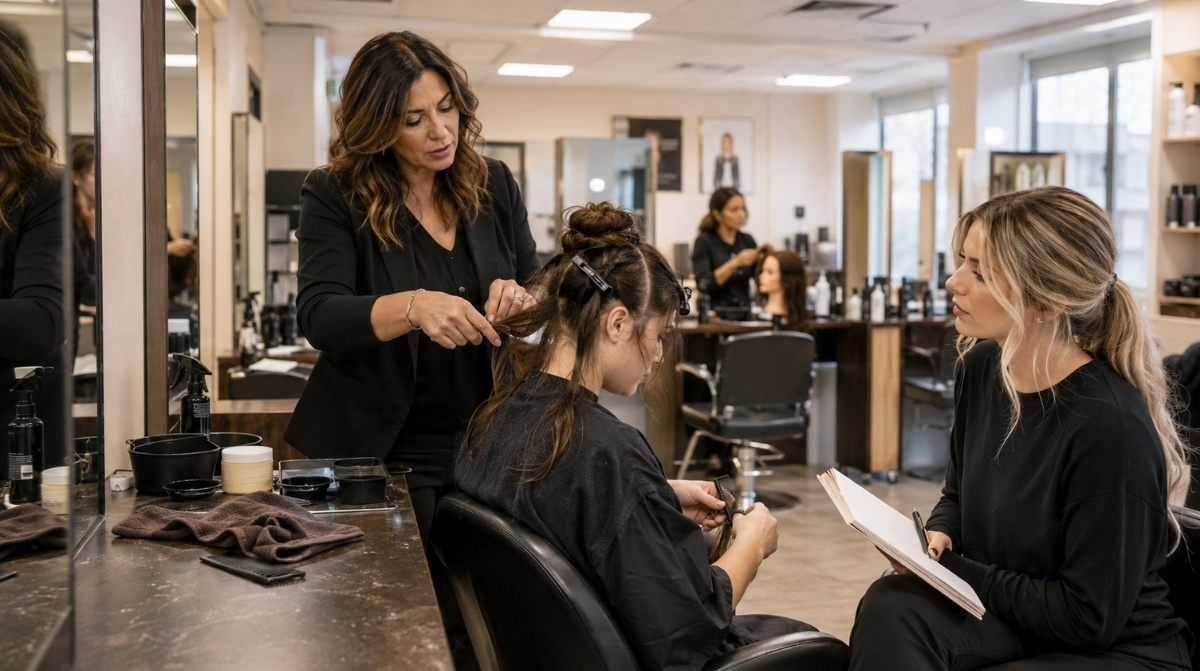
A professional beauty instructor demonstrates hair sectioning on a mannequin head for two students in a bright salon classroom setting.

The Value of the Human Touch

Predictions from Mintel’s 2026 global beauty and personal care report suggest we are entering a “Human Touch Revolution.” Even with the rise of technology, clients still want beauty services that feel authentic and emotionally real. This makes the role of an instructor even more vital. You are teaching the parts of the job that an algorithm cannot do, such as how to handle a consultation with empathy or how to use intuition during a color correction.

Cosmetology Instructor Responsibilities and Daily Tasks

Once you begin your beauty school instructor training, you will notice that the daily workflow is quite different from a salon schedule. Your cosmetology instructor duties involve a mix of classroom theory and practical supervision on the clinic floor.

In the classroom, you might lead a beauty instructor training program session on the chemistry behind permanent waves. On the floor, you watch students work on real clients. You act as a guide for their hands rather than performing the service yourself. I think it is important to ensure every student stays within their scope of practice. According to Georgia law, esthetics includes beautifying and stimulating the skin, but it specifically excludes diagnosing medical conditions or using lasers.

A typical day for a beauty school educator includes:

  • Creating lesson plans that follow state-mandated standards.
  • Showing students how to perform techniques safely and effectively.
  • Grading tests and evaluating practical skills.
  • Recording student hours to make sure they qualify for licensing.
  • Supervising the safety and sanitation of the tools and equipment.
  • Managing student-client interactions to ensure professional standards.
  • Teaching “soft skills” like business building and client retention.

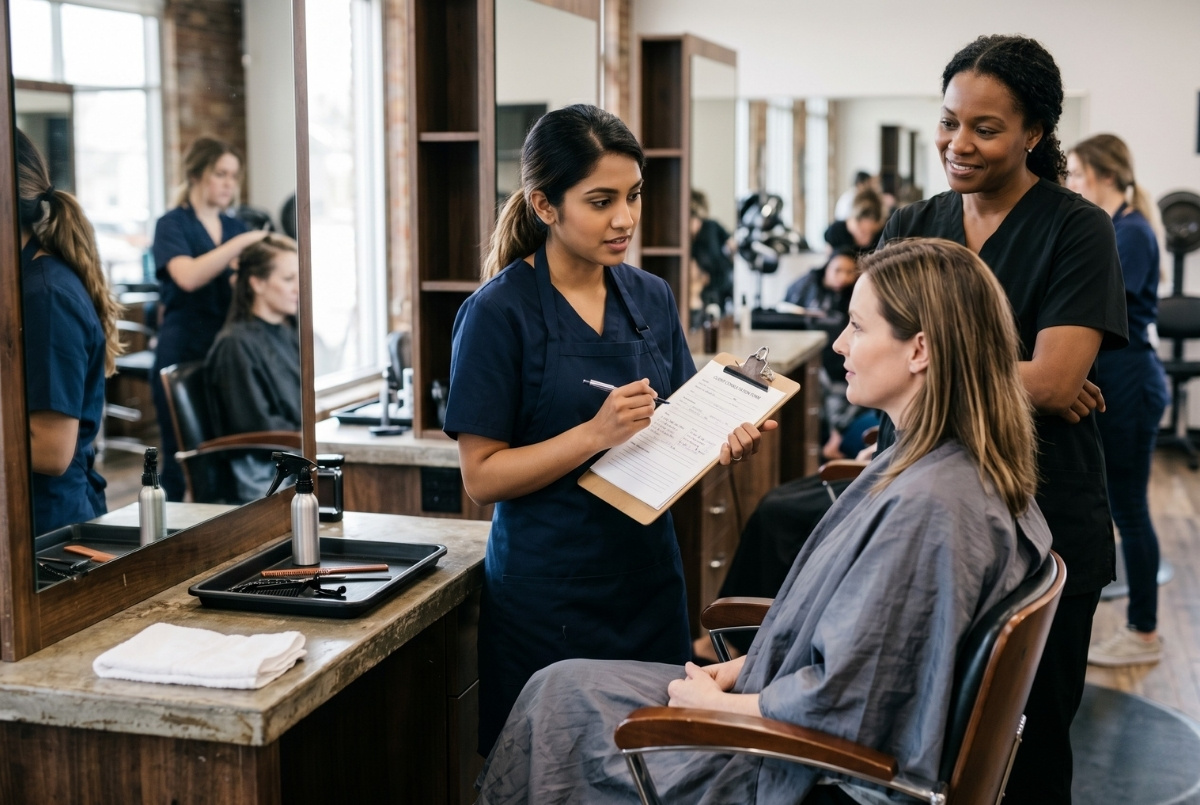
A student practicing a client consultation with a clipboard under the supervision of a beauty school instructor in a salon setting.

Understanding Beauty School Instructor Salary and Pay

The “feast or famine” nature of commission-based pay is a major stressor for many stylists. This is exactly why the average pay for a cosmetology instructor can be so appealing. It may provide a more predictable paycheck, and school-based positions may include benefits like health insurance or retirement plans, depending on the employer.

If you are looking for data on how much does a cosmetology instructor make, I find it best to use public benchmarks. O*NET places this role under the category of Career and Technical Education Teachers. For this group, the U.S. Bureau of Labor Statistics reports a median income of $61,490.

Other sources show even higher potential. For instance, Franklin University mentions a median salary of approximately $83,637 based on recent market data. While these numbers vary by location, employer, experience, and role type, the broader BLS career and technical education teacher data shows that the top 10% can earn more than $101,510.

The education market is still significant. Reports from Business Research Insights value the global beauty school market at $9.61 billion by 2026. This does not guarantee instructor demand in every city, but it does show that beauty education remains a sizable market. Schools that want strong student outcomes need qualified people who understand both the technical side and the “method of teaching.”

Steps to Become a Licensed Beauty Instructor

Moving into this field requires a specific beauty instructor license. You cannot teach based on your talent alone; you must also demonstrate that you know how to educate others. Most people find that an instructor license is built directly on the beauty license they already hold.

Here are the requirements to be a cosmetology instructor or a specialized teacher:

  1. Maintain an Active License: You need a current license in the specialty you want to teach, such as hair design, nails, or esthetics.
  2. Professional Experience: Many states have experience requirements. In Georgia, applicants generally need at least one year of work experience in their field.
  3. Enroll in an Approved Program: You will need to complete a state approved beauty instructor training program. These classes focus on classroom management, curriculum design, and how to evaluate students.
  4. Complete Your Training Hours: The number of hours you need depends on your goal. According to Georgia curriculum rules, cosmetology instructor training takes 750 hours. Training for esthetician instructors is 500 hours, and nail care instructors require 250 hours.
  5. Pass the State Exams: You will take a state board exam that covers both your technical knowledge and your ability to teach effectively.

The Science of Teaching

Licensing is not just a formality. It is about proving you can explain, supervise, and mentor. Georgia’s curriculum includes a heavy focus on teaching principles and lesson planning. Other regions are also emphasizing this; for example, South Carolina Bill 4752 proposes a dedicated course requirement for the “method of teaching.” This proves that being a great stylist is only half the battle; being a great teacher is the other half.

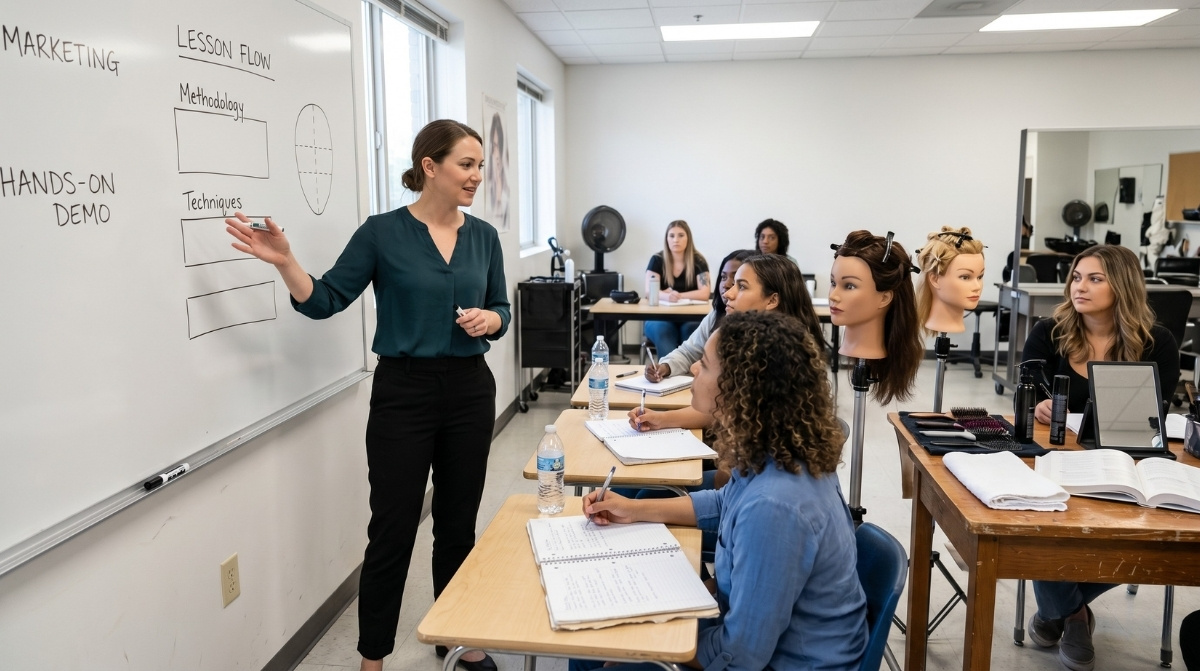
A professional beauty educator explaining a lesson flow diagram on a whiteboard to students in a modern training classroom.

Learning in the Digital Era

I often hear people ask if they can get a cosmetology instructor license online. The reality is usually a hybrid approach. While some schools may offer online beauty educator course options for theory topics like lesson planning, instructor training is still state-specific. Many programs still require supervised practice teaching, and Georgia includes supervised practice teaching as part of the instructor curriculum. Finding a school that offers a flexible schedule can help working professionals continue earning income while they complete their credentials.

Your Next Step at Perimeter Beauty and Barber Institute

I believe that becoming an educator is an investment in your own future. You are taking your years of experience and turning them into a stable, respected career. At Perimeter Beauty and Barber Institute, we have more than 20 years of history helping students and professionals pursue beauty education. Our leadership team has over 80 years of combined expertise in the industry, and we focus on making sure future instructors feel confident leading a classroom from day one.

Perimeter offers instructor training for experienced professionals who want to share their knowledge in cosmetology, barbering, nails, and esthetics. Because licensing rules and program requirements can vary by specialty, the best next step is to review the current school information and speak with admissions directly. If you want to see how our experience can help you reach your goals, I encourage you to check out our Enrollment page for more details. We have a contact form at the bottom of this article where you can reach out to us directly. I would love to help you start your journey as a mentor.

FAQ: Common Questions About Beauty Education

How long does it take to become a cosmetology instructor?
Most students finish their programs in 6 to 12 months. In Georgia, the hours vary by specialty: 750 for cosmetology, 500 for esthetics, and 250 for nail care.

What is the difference between an instructor and an educator?
The terms are often used the same way, but an instructor usually works in a licensed school setting. An educator might work for a specific product brand or travel to different salons.

Can I get my beauty instructor license for free online?
You might find free workshops, but a state license requires an approved program and formal exams. Some theory work may be available online depending on the school and state, but supervised practice teaching and licensing requirements still depend on your state.

What can I do with this license?
Beyond teaching in a classroom, you could become a school director, a brand representative, a curriculum designer, or even a state board examiner.

Esthetician Vs Medical Esthetician: Everything You Need To Know About Clinical Skincare

I’ve noticed a pattern lately with professionals in the skincare world. Many of us reach a point where the standard routine of steam, extractions, and basic hydration doesn’t feel like enough anymore. There is often a moment where you feel like you have hit a ceiling, both in terms of the results you can provide and the income you can generate. Moving from being a basic esthetician vs master esthetician or looking into the world of medical-level specialties is usually how most people break through that plateau. It is a way to finally get a seat at the table in the clinical skin health industry.

Key Takeaways

  • Market Growth: The medical aesthetics sector is projected to grow from $14.93 billion in 2025 to $16.79 billion by 2026, with continued growth projected through 2030, according to Research and Markets.
  • Legal Distinction: Master Esthetician is a specific legal tier in states like Virginia, while medical esthetician is typically a job title rather than a separate government-issued license.
  • Higher Earnings: Advanced services can create stronger earning potential, but compensation depends on your state, license type, employer, commission structure, and whether you also hold a medical license such as RN, NP, or PA.
  • Safety First: A 2025 FDA Safety Communication warned about serious RF microneedling complications, including burns, scarring, fat loss, disfigurement, and nerve damage, reinforcing the need for proper training and clear scope-of-practice compliance.

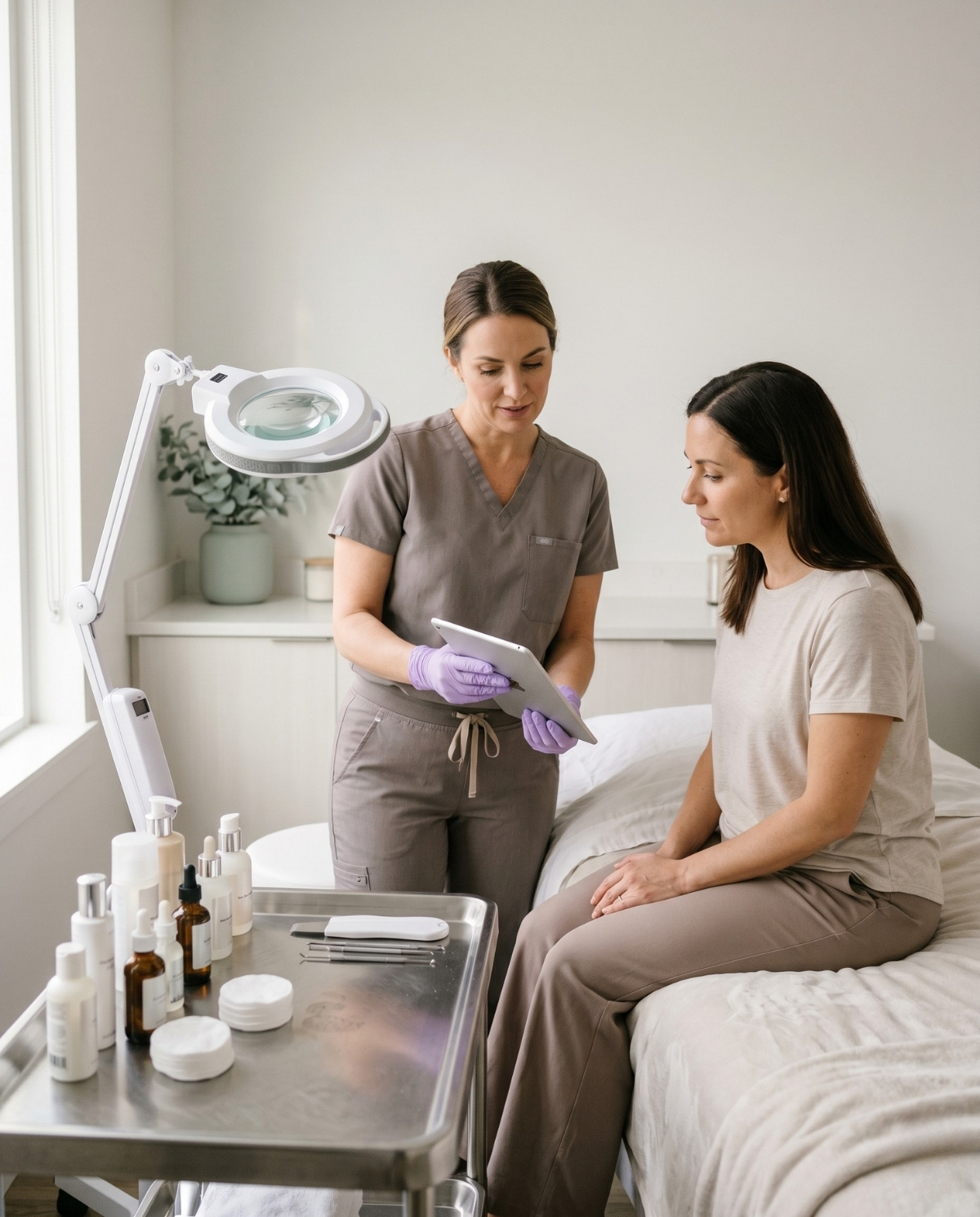
A professional esthetician in taupe scrubs and purple gloves uses a tablet to consult with a client in a bright, modern skincare clinic featuring a magnifying lamp and treatment tools.

The Different Levels of Esthetics

Most initial training programs focus on the lipid barrier, which is the skin’s natural protective shield. This foundation is vital, but if you are just starting out, I find it helpful to look at the entire process of becoming an esthetician, including school costs and requirements, before you decide to specialize.

The industry in 2026 is moving fast toward advanced practice (AP), medspa roles, and clinical esthetics. The most important thing to remember is that while advanced certificates look great, they don’t always change what you are legally allowed to do. Before you start offering things like lasers, IPL, RF, microneedling, injectables, or deeper chemical peels, you have to check with your state cosmetology or esthetics board and, when medical procedures are involved, your state medical or nursing board.

To understand what is a master esthetician, we can look at the Virginia model. According to the Virginia Administrative Code, that state requires a 600-hour basic program followed by a 600-hour master program. This means a total of 1,200 hours. In other states, like Georgia, you might see a single 1,000-hour esthetician program that covers the state-required foundation for licensure.

This higher level of education involves a much deeper look at anatomy, chemical exfoliation, and lymphatic drainage. In Virginia, the scope of practice even allows for specific advanced exfoliation like Jessner’s solutions. These services involve controlled injury to the skin, which requires a much better understanding of skin chemistry than a standard facial.

Entering the Medical World

I see a lot of people getting confused about the difference between an esthetician vs medical esthetician. In the vast majority of the U.S., a medical esthetician is just a job title. It usually means you are an esthetician working in a medical setting like a plastic surgery center or a dermatology office with esthetician services.

The Research and Markets data shows that the market is expanding because people are choosing non-surgical treatments more often. They expect the market to hit $26.2 billion by 2030. This growth is why we see so many more jobs for medical esthetician roles opening up in clinics and medspas.

When you work in these clinical environments, you have to follow the protocols of the medical director. However, that doesn’t mean your state board rules disappear. Your exact services still depend on your license, state board rules, medical-board delegation rules, and the supervising provider’s protocols. You might support a doctor in treating skin issues related to medical conditions, such as the unwanted hair growth associated with PCOS. While the doctor handles the diagnosis and treatment planning, the esthetician may handle aesthetic support when the service is legal for that role. If you’re interested in the money side of things, you can look into the different career paths and salary expectations in today’s market.

Nursing and Aesthetics

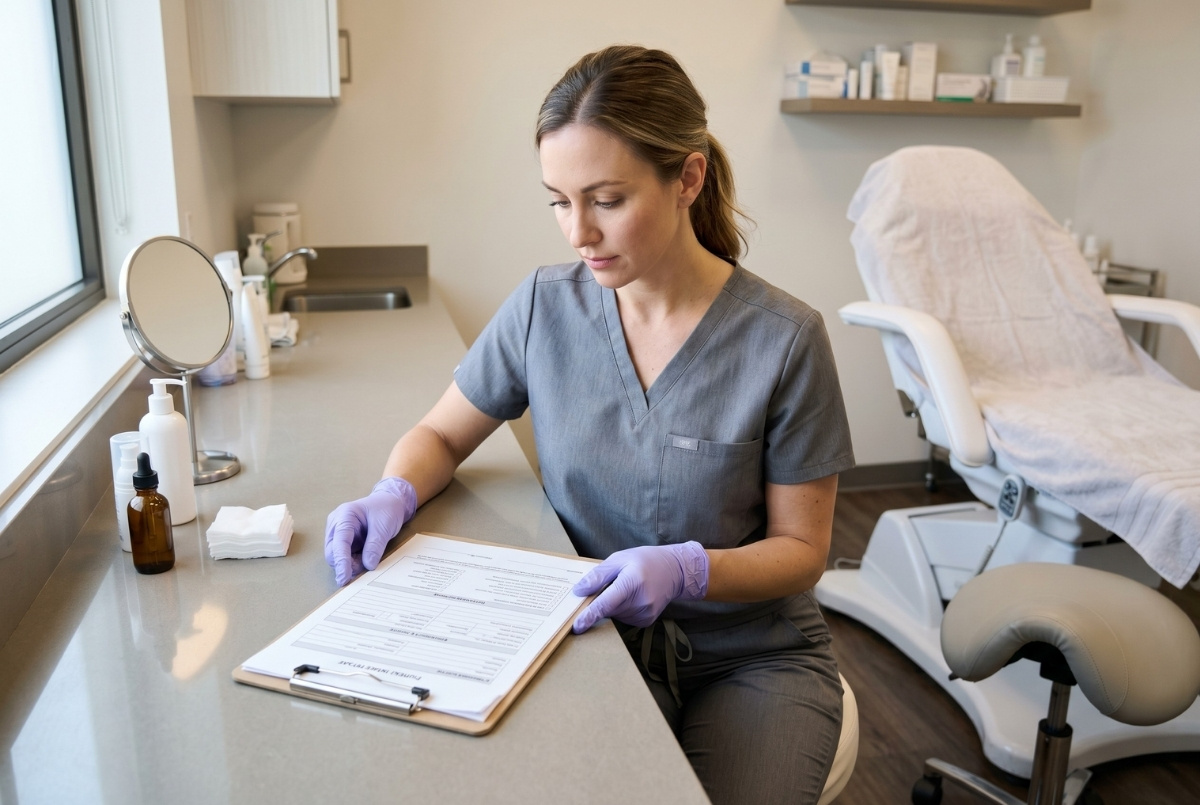
A medical professional wearing grey scrubs and purple gloves reviews a patient intake form on a clipboard in a clean aesthetic clinic.

One of the biggest trends I’m seeing this year is medical esthetics for nurses. Many registered nurses are looking for a change from the hospital environment. If you are an esthetician with RN license, you may have an advantage because the nursing license can open doors to medical-aesthetic services that an esthetician license alone does not cover. In many states, neurotoxin injections like Botox and dermal fillers are performed by licensed medical professionals under state nursing, medical, or delegation rules.

This is why an esthetician nurse may have stronger earning potential than a traditional skincare-only role. For comparison, the U.S. Bureau of Labor Statistics noted that skincare specialists had a $19.98 median hourly wage in May 2024. Transitioning from RN to esthetician work allows you to combine medical skills with skincare, but your ability to inject always comes from the medical license, not the esthetics one.

How State Rules Vary

Your path to an advanced career depends entirely on where you live. Every state has a different rulebook:

  • Virginia: If you want to know how to become a master esthetician in Virginia, you need the two-tier 1,200-hour total training as per the Virginia Administrative Code.
  • Florida: To become a medical esthetician in Florida, you have to navigate the split between beauty and medical-adjacent services. The Florida Department of Health notes that laser hair removal is regulated through electrology and must be supervised by a physician.
  • California: There is no official master license here. The California Board of Barbering and Cosmetology is very strict and states that estheticians cannot use lasers for treatment, even if a doctor is watching.
  • Pennsylvania: According to the state’s licensure snapshot, PA requires 300 hours for a license and does not have a master tier.

Staying compliant is the most important part of growing your business, which is why I suggest checking out this guide on passing state boards and understanding transfer rules.

High-Intensity Services: Botox, Lasers, and Microneedling

A close-up of clear protective eyewear on an open training manual with skin diagrams, surrounded by blue gloves and aesthetic device tools.

As you move into what is an advanced esthetician role, your menu might change to include more intense tools.

  • Injectables: Generally, estheticians cannot do Botox or fillers through an esthetician license alone. These are medical procedures and generally require an appropriate medical license, such as RN, NP, PA, physician, or another credential allowed by state law. However, an esthetician working under a doctor is essential for patient education, treatment support, and post-care.
  • Microneedling: The rules on how deep can an esthetician go with microneedling change depending on the state, especially when treatment reaches the dermis or uses radiofrequency energy. Some medical settings may allow properly licensed or delegated personnel to perform these treatments under supervision, while other states may prohibit estheticians from performing microneedling even with a private certificate.
  • Lasers: To become a laser esthetician, you have to understand the physics of how light targets pigment, blood vessels, hair follicles, or water in the skin. Always confirm if your state allows estheticians to operate laser devices, requires a separate laser or electrology credential, or limits the service to medical professionals.

The Safety Factor

The 2025 FDA Safety Communication about RF Microneedling is a big deal. It mentioned serious risks including burns, scarring, fat loss, disfigurement, nerve damage, and the possible need for medical or surgical intervention. The FDA also described RF microneedling as a medical procedure, not a cosmetic treatment. This is a reminder of why high-quality training is so important before moving into advanced services. You have to understand device physics, tissue response, sanitation, contraindications, and legal scope to keep your clients safe.

Elite Credentials

If you want to reach the top of the field, you might look at the CIDESCO Diploma. It is one of the best-known international beauty and spa therapy credentials, with standards that have been around since 1957. It can be especially useful if you want a globally recognized qualification instead of relying only on state-level licensing.

I also recommend looking into certifications to get after esthetician school that cover new topics like exosomes or polynucleotides. These are often discussed as next-generation skin-repair treatments, but they should be approached carefully in the U.S. because many involve medical products, injections, or regulatory limits outside a standard esthetician scope. Even if your license doesn’t let you perform the injection part of these treatments, knowing the science makes you a better consultant for your clients.

Taking the Next Step

The data makes it clear that the future of skincare is becoming more clinical. The demand for knowledgeable specialists is higher than I have ever seen it. If you want to reach that top tier, you need a foundation that goes beyond the basics.

At Perimeter Beauty & Barber Institute, the focus is on a “Salon Ready” approach. This means you aren’t just reading from a book; you are getting hands-on experience, client communication skills, sanitation discipline, and professional habits that help prepare you for real service environments. I believe that having that kind of discipline is what separates a standard practitioner from a true leader in the industry.

If you are ready to see what is possible for your career, I invite you to find out more in Enrollment. You can also use the contact form at the end of this article to talk to the team about how to get started on your journey.

FAQ

What qualifications do you need to be a medical esthetician? Usually, you need your basic license plus advanced training in things like chemical peels, device safety, and clinical sanitation. Remember that medical esthetician is a job title, so your actual scope depends on your state laws, your license, your employer, and whether the service is cosmetic or medical.

How to become medical esthetician without a degree? You don’t need a four-year college degree. You need to complete a state-approved esthetics program and then get extra training in medical-office protocols, patient communication, and pre/post-procedure care for clinical settings.

Can an esthetician do microneedling in Michigan or Massachusetts? This is often seen as a medical or medical-adjacent procedure, especially when it reaches the dermis or uses RF energy. Rules vary a lot by state and may involve cosmetology boards, medical boards, nursing boards, and delegation laws. I always recommend checking with the state board directly rather than just trusting a private certificate.

What Can You Do With an Esthetician License? A Detailed Guide to Careers and Salary

When people ask me about starting a career in the beauty industry, they usually want to know if there is a real path forward after graduation. Skincare is no longer just a luxury service; it is increasingly connected to wellness, prevention-minded routines, and long-term skin health. I have noticed that the most successful professionals in 2026 are those who treat their license as a foundation for a serious business while respecting the legal limits of their scope. You are likely looking for a career that offers both stability and room to grow, and fortunately, the options for where to work as an esthetician are expanding every year. Before you dive into the deep end, learning how to become an esthetician is the first step toward mapping out your future.

Quick Facts About the Industry

  • Job Security: The U.S. Bureau of Labor Statistics projects that employment for skincare specialists will grow 7% through 2034, which is significantly faster than most other professions.
  • Work Environments: You can find roles in medical offices, luxury resorts, retail settings, or even cruise-ship spas.
  • Earnings: The median wage in 2024 was around $19.98 per hour. However, roles in physician offices often pay more, with a median of $23.40 per hour. High earners and business owners may reach much higher levels through specialization, location, tips, commission, and ownership, but higher income should be treated as a possible upper-tier outcome rather than a guaranteed salary.
  • Business Ownership: About 26% of professionals in this field are self-employed. Running a business from home is a common goal, but you must stay on top of local zoning and state board rules.

Choosing Your Path: Where Do Estheticians Work?

One of the best things about this license is the variety it offers. I love that your daily environment can change based on your interests and your career goals. Your places to work are not limited to just one type of spa or salon.

Retail and Education

Major beauty retailers like Sephora and Ulta are huge employers for licensed professionals. These companies look for people who can educate customers on product science and provide specialized services. Ulta’s career page and Sephora’s jobs site often list roles for beauty advisors and service providers. I think these are excellent esthetician jobs for beginners because they give you a chance to work with hundreds of different skin types and learn how consumers make buying decisions.

The Medical and Clinical Tier

If you prefer a more clinical setting, you might look into jobs with dermatologist offices or plastic surgery centers. This is often called medical esthetics, though your legal license remains the same. In these roles, you usually focus on long-term treatment planning rather than a single relaxing session. According to Allergan Aesthetics research, 78% of consumers feel more satisfied when they have a long-term plan with their practitioner. This shift toward long-term aesthetic planning fits the broader “Bio-Aesthetics” idea: clients increasingly value barrier support, prevention-minded routines, age-prevention conversations, and realistic treatment plans, as long as every service stays within the provider’s legal scope.

Travel and Luxury Resorts

For those who want to see the world, esthetician jobs on a cruise ship are a unique option. Companies like OneSpaWorld recruit professionals to provide high-end wellness services at sea. These roles are fast-paced and offer a global perspective on beauty. Similarly, destination resorts and five-star hotels hire estheticians to provide polished, professional experiences for guests who expect top-tier service.

Understanding Your Scope: What Can You Do With an Esthetician License?

Before you start applying for jobs after esthetician school, you must understand your scope of practice. This is the legal boundary of what your license allows you to do. In 2026, a great professional is one who knows exactly when a client needs a treatment and when they need a referral to a doctor.

The BLS notes that skincare specialists perform face and body treatments to improve a client’s appearance. For those in Georgia, the law is very specific. Georgia state law includes services like facial massage, brow shaping, and lash services within our scope. However, it explicitly states that esthetics does not include diagnosing or treating dermatological conditions, medical aesthetics, or using lasers. I always tell students that being career-ready means knowing these legal limits. If you want to visualize the daily life of a student, you should check out our guide on what is esthetician school like.

Esthetician Salary and Earning Potential

I know that the average salary for an esthetician is a major factor in your decision. While the national median is around $41,560 per year, your actual take-home pay depends on several factors. Most professionals earn a mix of an hourly pay rate, service commissions, and tips.

The BLS reports that the top 10% of skincare specialists earn over $77,330 per year. Working in a physician’s office can increase the median wage, and specializing carefully may help you build stronger long-term earning potential depending on your market, service menu, client retention, tips, commission structure, and business model. I have seen that professionals who focus on client retention and rebooking strategies tend to have the most stable and high-paying careers.

Entrepreneurship: Can You Work From Home?

Many of my readers dream of starting an esthetics business from home. While going solo gives you control over your schedule and pricing, it comes with a lot of responsibility. You are not just a service provider anymore; you are a business owner.

  • Legality: You must meet state board facility requirements. The Georgia Secretary of State explains that you need a specific salon/shop license in addition to local business permits.
  • Safety: You must ensure every service stays within your scope. For example, the FDA provides strict guidance on things like microneedling devices, which are often classified as Class II devices.
  • Costs: You are responsible for insurance, taxes, supplies, and marketing. I think this path is rewarding, but it requires a solid plan before you leave your day job.

Advancing Your Career: RNs and Specializations

Your career doesn’t have to stop at a basic license. There are many ways to specialize and increase your value in the industry.

RN to Esthetician

Registered Nurses are increasingly moving into the aesthetics field. This crossover allows for more clinical involvement, but it still follows strict rules. The Georgia Board of Nursing states that an RN may perform cosmetic injections only when authorized by a valid individualized order from a physician, nurse practitioner, or physician assistant with prescriptive authority. Standing orders are not an appropriate substitute, and a history and physical exam must be performed by the medical provider first.

Master Estheticians and Instructors

Some states, like Washington, offer a Master Esthetician license for advanced services. In other regions, you might choose to become an instructor. Teaching at an academy is a great way to stay sharp on technical skills while helping the next generation enter the field.

Getting Hired: Resume and Interview Tips

When you are looking for how to get a job as an esthetician with no experience, you should focus on your professional habits. I recommend building a portfolio that shows your clinic hours and sanitation standards. Employers in 2026 are looking for reliability and a client-first mindset.

During your interview, be prepared for a practical exam where you perform a service. They will watch how you set up your station and how you explain post-care routines. I suggest practicing your answers to common esthetician interview questions, such as how you handle skin reactions or how you recommend products based on a client’s specific lipid barrier needs.

Take the Next Step in Your Career

The data shows that the demand for skincare specialists is growing, and consumer interest in long-term skin health is strong. A license is a powerful tool, but your success depends on the quality of your training. At Perimeter School, I believe in a “Salon Ready” approach that prepares you for the realities of a professional environment. We focus on hands-on experience, sanitation discipline, and the communication skills you need to build a loyal client base.

If you want to understand more about the licensing process, please see our guide on how to apply for an esthetician license. Our instructors bring decades of combined experience to the classroom, helping you bridge the gap between graduation and your first paycheck.

To start your journey, you can find out more in Enrollment. We have a contact form at the end of that page where you can reach out to our team to discuss your goals and tour our facility. I look forward to seeing where your ambition takes you in the beauty niche.

FAQ: Common Career Questions

Is it hard to find a job as an esthetician? The outlook is very positive. With a 7% growth rate, there are many roles available in spas, retailers, and medical offices. New graduates should focus on building a strong portfolio and demonstrating professionalism.

What career cluster does an esthetician fall under? This job is typically part of the Human Services cluster. Some modern frameworks group it under Healthcare & Human Services because of the focus on wellness and client support.

Can I move my license to another state? Many states offer reciprocity, but every state has different requirements for hours and testing. I recommend checking the specific rules for your destination state early in the process.

Do I need a degree to be a medical esthetician? You usually only need a state-approved esthetician or cosmetology license. While you don’t need a four-year degree, you must stay within your state’s legal scope, as a basic license does not allow for medical diagnoses, treatment of dermatological conditions, medical aesthetics, lasers, injectables, or other services outside your state’s scope.

How to Apply for an Esthetician License: Passing Your State Boards and Transferring States

Starting a career in skincare is an exciting journey. I know firsthand that finding clear information about local regulations can be quite overwhelming. Every area has its own set of rules regarding how much training you need, the specific tests you must pass, and what tasks you are legally allowed to perform. I want to help you understand the entire process so you can focus on building your skills instead of stressing over paperwork. Here is my complete breakdown to help you navigate schooling, prepare for the state board exams, and earn the right to practice professionally.

Key Takeaways

A close-up photograph of an esthetician training desk featuring an open workbook, a practice mannequin head, and labeled skin care tools in a bright, modern beauty school classroom.

What Does It Take to Become a Licensed Professional?

Required Training Hours and Local Differences

I always tell my readers that you cannot legally perform professional skin care without official schooling. When you compare the esthetician requirements by state, the training time is the biggest variable. The required hours reflect how each local board views training standards and the scope of practice. Some areas require fewer hours for basic services, while others demand long programs.

Here is a quick look at current esthetician hours by state:

Online Schooling and the Cost of Education

Many students balancing a job ask me if they can get an esthetician license online. A fully remote path simply does not exist. According to some distance learning standards, a few programs might offer theory classes digitally. Hands-on practical training is still mandatory to graduate and qualify for your exams.

As for the financial side, people often wonder how much it costs to get an esthetician license. Tuition generally falls between $4,000 and $12,000. I suggest looking at our comprehensive guide on how to become an esthetician and handle the costs to understand this better. I view tuition as the core foundation of my career because your investment dictates your clinical experience before graduation.

Preparing for the State Board Exams

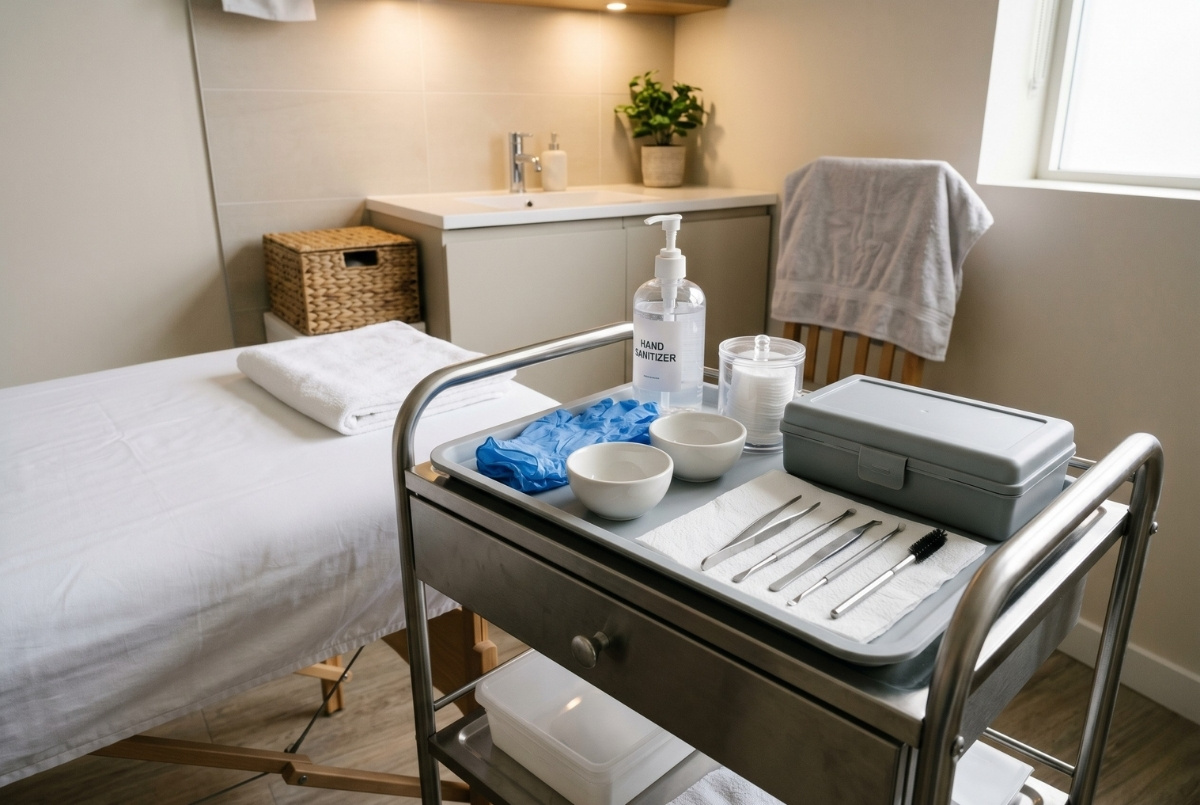
A detailed interior photograph of a clean, well-organized skincare treatment room featuring a stainless steel medical rolling cart in the foreground. The cart's tray holds hand sanitizer, blue nitrile gloves, cotton rounds, mixing bowls, and various facial extraction tools (tweezers, extractors) on a sterile wipe. In the background is a white treatment bed with a folded towel, a sink area with cabinets, a wicker basket, and a potted plant, all illuminated by soft natural light.

Surviving the Written Theory Exam

Your esthetician written exam will test you heavily on infection control, science, and sanitation. You will tackle subjects like microbiology, product chemistry, and state laws. If you are wondering how many questions are on the esthetician state board exam, the NIC theory format currently features 110 items, with 100 counting toward your score. Using a solid esthetician written exam practice test is the smartest way to prepare for these specific questions.

The Hands-On Practical Exam

The practical exam for esthetics causes the most anxiety for students. Examiners are not judging how relaxing your service is. They score you on strict sanitation, organization, and how you handle contamination risks. Reading up on what esthetician school is like day-to-day helps you understand the muscle memory needed to pass this section.

Also, keep in mind the upcoming NIC exam updates. Blood exposure procedures will be revised starting in March 2026. Infection control is going to remain the central focus of your practical exam.

Handling Applications and Background Checks

How to Apply After Passing Your Exams

Getting a passing score for the esthetics exam does not automatically give you your credentials. You still need to submit your application and fees. For instance, New York requires you to apply through its online licensing system, while Florida handles registrations through the DBPR portal.

Navigating Criminal History Evaluation

I also hear from readers worried about their past, asking if you can get an esthetician license with a felony. Many boards review criminal records on an individual basis. Texas looks at convictions individually and even offers a criminal history evaluation process so you know where you stand before applying. Honesty is always the best policy when dealing with your local board.

Moving States and Building Your Career

Transferring Your License to Another State

If you plan to relocate, you have to understand how to transfer an esthetician license from state to state. Most areas offer licensure by endorsement, which means they review your existing training and work history. New York allows endorsement for out-of-state professionals. Similarly, Virginia and its licensing requirement summary show pathways for endorsement based on your experience.

I see a lot of misinformation about the Cosmetology Licensure Compact. It has reached the legislative threshold, but it is not active yet. It is also built for cosmetologists, so estheticians cannot use it as a shortcut right now.

Renewing Credentials and Going Solo

Keeping your status active requires paying attention to renewal cycles. Florida mandates renewal every other year. If you get married, states have specific update protocols, like California’s formal name change process.

Earning this legal status gives you the freedom to shape your career. The Bureau of Labor Statistics highlights that many skincare specialists go on to become self-employed.

A cozy independent skincare studio with a white treatment bed, a black rolling tool cart, and a wooden desk with client paperwork in a room with warm neutral decor and natural window light.

Ready to Master Your Craft?

You now know how to navigate the local regulations and testing processes. The next important decision is finding a reliable educational partner.

At Perimeter Beauty & Barber Institute, we focus heavily on preparing you for a thriving, independent career. I highly encourage you to find out more details about our admissions process over at Enrollment. We want to ensure you have all the information you need to make the best choice for your future.

Please fill out the contact form below to connect with us. We are happy to discuss your goals, explain the required hours, and help you get started on this amazing career path.

Frequently Asked Questions

Do you need a license to be an esthetician?
In the United States, you generally need the appropriate state credential to legally perform professional skincare services. The exact credential title varies by location. For example, Florida uses a Facial Specialist registration rather than a standard esthetician title.

How many questions are on the esthetician state board exam?
If your state uses the NIC theory format, the current exam contains 110 items, with 100 scored. State-specific testing formats can vary, so I always recommend confirming your current candidate bulletin.

How do I look up where to get my esthetician license testing done?
Your state board or testing vendor will provide the scheduling path. New York handles application and exam scheduling through its online licensing system, while Georgia directs examination candidates to PSI.

How do I find specific esthetician license requirements by state?
Go straight to the official regulator. Earning an esthetics license in NY means checking the New York Department of State, while transferring credentials into Virginia means reviewing the Virginia Board for Barbers and Cosmetology.

What Is Esthetician School Like? A Full Guide to Classes, Hours, and Preparation

Many people spend years as dedicated skincare consumers, decoding ingredient labels and building their own multi-step routines. However, the shift from your own bathroom mirror to a professional treatment room represents a major career milestone. This change turns a personal interest into a licensed profession, and many prospective students feel both excitement and a little academic self-doubt as they wonder whether they can master the clinical theory, strict sanitation rules, and hands-on skills required to succeed.

This guide moves past the usual surface-level talk to show you the structured, skills-driven reality of what you will experience during your training.

Key Takeaways

  • Industry Growth: Employment for skincare specialists is projected to grow 7% from 2024 to 2034, which is faster than the average for all occupations.
  • Science-Driven Training: Modern programs focus heavily on skin barrier function, ingredient literacy, sanitation, and client safety alongside traditional facial techniques.
  • Compliance Matters: The Modernization of Cosmetics Regulation Act (MoCRA) has increased the importance of cosmetic safety and labeling awareness for everyone in the beauty industry.
  • Flexible Pathways: Training requirements vary significantly by state, ranging from a 220-hour facial specialty in Florida to 1,000 hours for esthetician training in Georgia.
  • Earning Potential: Income depends on location and specialty; the BLS reports a median wage of $19.98 per hour for skincare specialists, though advanced or highly specialized roles may earn more.

What Is Esthetician School Like?

A woman in green medical scrubs and blue gloves seated at a desk, looking down at handwritten notes in a notebook next to a tray of professional extraction tools, with a white treatment chair and product shelves in the background.

Modern esthetics training typically feels less like a traditional lecture-based classroom and more like a professional clinic. A strong esthetician program blends theory with repetition. Students study skin structure, infection control, and product chemistry before applying that knowledge in supervised practice. Most days are built around a split between classroom instruction and hands-on clinic work.

During esthetician training, students learn how to perform professional consultations, identify visible skin concerns within their scope, and maintain high sanitation standards. Most programs cover the fundamentals, including facials, hair removal, and lash services. Just as important, students learn the pace and discipline of a professional environment, from tool disinfection to treatment documentation. If a school offers services to the public, students may also gain experience working with real clients to build confidence.

Expert Insight: Demand for Faster, Lower-Cost Services

According to the U.S. Bureau of Labor Statistics, employment for skincare specialists is projected to grow 7% from 2024 to 2034. The BLS also notes that demand is supported by services like mini-sessions and mobile facials, which appeal to clients looking for convenience and more affordable price points.

The Science of the Barrier: What You Actually Learn

Many new students worry most about the hard science side of esthetics. In reality, that scientific foundation is exactly what gives the profession its credibility. A quality program teaches not only how to perform services but why certain products, ingredients, and treatment steps matter for skin health and safety.

An open notebook showing a skin layer diagram sits on a desk alongside facial brushes, a glass bowl, blue gloves, and a white magnifying lamp.

Biology, Chemistry, and Safety

Students typically spend significant time learning about skin anatomy, barrier function, and pH. They also learn why recognizing contraindications and visible conditions matters for client safety, including when a client should be referred to a medical professional.

Advanced Skill Development

Hands-on esthetician training usually covers cleansing methods, massage movements, extractions, hair removal, and makeup fundamentals. Students learn treatment techniques that protect skin integrity and avoid unnecessary trauma. Even if they plan to focus solely on skin care, a thorough understanding of makeup and product interactions can still be useful in treatment settings.

The Logistical Roadmap: Hours, Costs, and States

The biggest logistical reality is that training requirements vary by state, which shapes how long it takes to complete esthetician school.

  • Georgia: 1,000 esthetician hours for Georgia licensure.
  • Texas: 750 esthetician hours for Texas.
  • California: Esthetics remains a separate licensed category, while California schools commonly operate under the state’s post-SB 803 framework for revised beauty-program hour structures.
  • Arizona: 600 esthetician hours for Arizona.
  • Florida: 220 hours for a facial specialty or 400 hours for a full specialty.

If speed is your priority, the quickest way to become an esthetician depends on your state and your schedule. Some full-time programs can be finished in a matter of months, while others take closer to a year. You can often find an esthetician school with weekend or night classes to make the schedule more manageable. While some theory may be offered in hybrid form, state-approved practical training must still be completed in person.

Expert Insight: Compliance and Safety in 2026

The FDA’s Modernization of Cosmetics Regulation Act (MoCRA) has increased the focus on cosmetic safety and recordkeeping in the beauty industry. As a professional, estheticians focus on safe work practices and documenting incidents appropriately. Following state board rules ensures professional responsibility without necessarily requiring direct federal FDA reporting for every product used in a treatment room.

Financial Strategy: Funding Your Education

Tuition varies significantly by school and location. Many programs fall into the several-thousand-dollar range, and students should always ask if their esthetician kit for school and textbooks are included in the headline price.

For students watching their budget, it is smart to verify financial aid options directly with the school. Not every institution qualifies for federal aid, so students should confirm that with the school’s financial aid office before assuming eligibility.

Professional Prep: Your First Day and Beyond

Before your first day, confirm the specific requirements to get into esthetician school in your state. In many places, students can attend esthetician school with a GED or a high school diploma, though minimum age requirements vary.

Once enrolled, students will likely receive a professional kit containing supplies and practical tools used during training. Early practice usually begins on mannequins or classmates before students advance into supervised clinic work. This transition is where confidence really starts to build as theory connects with touch.

The State Board: Your Final Hurdle

A student in green scrubs prepares a tray of tools next to a treatment chair while an instructor watches with a clipboard.

The last step to the career is the licensure process. This usually involves a written exam, a practical exam, or both. Reviewing sanitation rules, service procedures, and state laws helps students prepare for the exam process and the legal requirements of practice.

Income after licensure can vary quite a bit. According to the U.S. Bureau of Labor Statistics, skincare specialists had a median wage of $19.98 per hour in May 2024. Beauty Insurance Plus also points out that specialized or luxury roles can reach much higher earnings through commissions, retail sales, and business ownership.

Ready to Master Your Craft?

Choosing a beauty school involves more than just meeting a state hour requirement. You are selecting an environment where you will build the technique and professional confidence needed for a long-term career. At Perimeter Beauty & Barber Institute, we focus on a “Salon Ready” approach designed to prepare students for the daily rhythm of real-world beauty industry work.

Whether your goal is to work in a spa or eventually build your own business, having the right training environment matters. Perimeter brings more than 20 years of experience and a combined instructor experience of more than 80 years to its training programs.

Proper education is the difference between simply learning procedures and building a lasting career. If you are ready to take the first step, the next move is to find a program that fits your goals and state standards. You can find out more in Enrollment.

Please fill out the contact form at the bottom of this article to schedule a tour of our campus or to speak with an admissions coordinator about our upcoming start dates. Your path toward licensure can start here.

FAQ: Professional Path Clarity

Can I attend school while working a full-time job? Many programs offer evening, weekend, or part-time schedules to make training more manageable for working adults.

Is it difficult to get accepted into esthetician school? Admission is usually based on meeting age and education requirements rather than on a competitive GPA.

Can a registered nurse attend esthetician school? Yes. Nurses sometimes pursue esthetics training to expand into skincare-focused or medically adjacent beauty settings, though the exact services they can perform depend on state law.

What distinguishes a basic esthetician from a master esthetician? This depends on the state. Some states use advanced designations with additional training, while others do not use that license category at all.

Is a license required to perform services from a home-based studio? In most states, yes. Paid skincare services generally require proper licensure, and home-based operations must also meet local zoning and sanitation requirements.

How to Become an Esthetician: A Full Guide to School, License, and Cost

Choosing a career in skin health is a significant commitment. I believe that finding a path that matches your interest in skincare with a sustainable job market is essential. Moving from being someone who loves beauty products to becoming a professional skin expert requires a firm grasp of biology and chemistry.

The industry is growing, and there are many opportunities for those who know what they are doing. This guide walks you through the education for an esthetician, the standard requirements for an esthetician license, and the typical esthetician school cost.

Key Takeaways

  • Career Speed: You can often complete your training in 4 to 12 months, making it much faster than a standard four-year degree.
  • Market Growth: The Bureau of Labor Statistics expects the field to grow by 7% through 2034.
  • Earnings: The average yearly pay is roughly $45,374, though specialized Master Estheticians can earn more than $66,900.
  • Modern Rules: By 2026, the Modernization of Cosmetics Regulation Act (MoCRA) has raised expectations for safety and accountability across the beauty industry.

The Role of a Modern Esthetician

In 2026, the beauty world is moving toward “Metabolic Beauty,” a concept highlighted by Mintel analysts. This approach focuses on how internal wellness impacts the skin. As a licensed professional, your work revolves around protecting the lipid barrier, which is the skin’s natural defense against moisture loss and bacteria.

Your training involves using professional-grade peels and high-tech equipment to help with skin repair. Understanding these chemical processes is what makes you a professional. Clients are looking for “Bio-intelligent actives,” which are ingredients that adapt to the skin’s needs. Learning about skin biotechnology will give you a significant advantage in the job market.

An esthetician student in sage green scrubs performs a facial treatment on a client lying on a white treatment table in a bright clinic setting.

The Academic Path to Success

You need to meet a few basic criteria before you can start. Most states require you to be at least 16 or 17 years old. A high school diploma is also standard. Many people ask, “can you be an esthetician with a ged?” and the answer is yes, as state boards almost always accept it.

The steps for how to become an esthetician after high school are quite clear:

  1. Look for reputable schools with esthetician programs.
  2. Finish your required training for an esthetician.
  3. Successfully pass the state licensing exams.
  4. Submit your application for a license.

Learning In-Person vs. Online

When you look for the quickest way to become an esthetician, you might find options for an online esthetician course. I want to be realistic about this. While you can study things like anatomy or product chemistry through online classes for an esthetician, you cannot learn how to perform a safe chemical peel through a computer screen.

Most states require you to complete several hundred hours of hands-on work in a student clinic. If a program says you can finish esthetician school online without any in-person training, they are likely not accredited. Choosing a non-accredited school will stop you from getting a license for an esthetician, which makes the faster route a waste of time.

How Long Does Esthetician School Take?

If you want to know how many years of school for an esthetician are necessary, the time is usually measured in months. While the Bureau of Labor Statistics explains that you must finish a state-approved program, each state board sets its own hour requirements.

Most states require between 600 and 1,000 hours of training. This is how that usually breaks down:

  • Full-time: Many students finish in 4 to 6 months.
  • Part-time: These schedules often take 9 to 12 months.
  • State Differences: Florida requires about 260 hours for a facial specialty, while Georgia and Alabama require 1,000 hours for a full license.

This timeline allows you to start your career quickly. You spend less time in a classroom and more time in a clinic, which builds the confidence you need to be ready for a salon job after graduation.

An instructor shows skincare techniques on a mannequin head while adult students take notes in a classroom.

Investing in Your Future: Costs and Aid

The esthetician school cost is an investment in your career. Tuition can range from $3,000 at a community college with an esthetician program to over $15,000 at private beauty institutes. Some schools provide financial aid that can cover your fees.

Managing the cost is possible through several options:

  • FAFSA for esthetician school: You can apply for federal aid if your school is part of the Title IV program.
  • Grants: Certain schools offer grants for esthetician school that you do not have to pay back.
  • Military Benefits: The VA pays for esthetician school at many qualifying locations for veterans or their families.

When you calculate the cost to become an esthetician, remember to include the “kit fees.” These kits contain the professional tools and products you will use during your training and your first job.

Securing Your Esthetician License

Finishing your esthetician program is the first major step. After that, you must gain official recognition from the state board. Most states require a written test, and many still require a practical exam.

The two-part system generally looks like this:

  • Theory Exam: This written test covers skin biology, safety protocols, and state laws.
  • Practical Exam: This is a hands-on demonstration where you show your skills on a model or mannequin to prove your techniques are safe.

States like California have simplified their process recently, but Georgia still uses rigorous testing to ensure every licensed esthetician is ready for the field. The cost to get an esthetician license usually ranges from $100 to $250 for application and testing fees.

Opportunities After Graduation

The question of what you can do with an esthetician license has many exciting answers. You could work in:

  • Medical Spas: Collaborating with doctors on advanced skin treatments.
  • Resorts: Working in luxury settings around the world.
  • Self-Employment: Building your own business and specializing in niche services.

Data from ZipRecruiter in early 2026 shows that the average salary for an esthetician is around $45,374. Specializing in advanced treatments can increase your income. For example, a Master Esthetician often earns over $66,900 annually. Your esthetician yearly salary will likely grow as you gain experience and build a client list.

A smiling esthetician in a gray uniform stands with a clipboard beside a prepared facial bed and treatment lamp in a sunlit room.

Starting Your Professional Journey

Choosing the right place to learn is vital for your success. At Perimeter Beauty and Barber Institute, I believe in providing a path that leads to a real professional legacy. Our school has been in business for over 20 years, and our team has a combined 80 years of experience helping students enter the Georgia beauty industry.

We focus on creating graduates who are “Salon Ready” from the moment they finish. This means you build practical skills in skin treatments, product knowledge, client care, and professional techniques that prepare you for the workplace. Students also train with professional product lines like CHI as part of their education. Our goal is to make sure you feel completely prepared when you start your first job.

Our history is built on the success of students who turned their interests into a career. Your future in skin health is waiting, and we are here to help you through every step. You can find out more about how to get started in Enrollment. We also have a contact form at the end of this article if you have more questions about our community.

FAQ: Common Questions

Is it hard to get a job as an esthetician?
The demand for skin health experts remains high. Employers look for graduates who understand safety rules and have strong hands-on skills. Choosing a reputable school makes your job search much easier.

Can you be an esthetician without going to school?
No. Every state requires you to complete a specific number of educational hours at an approved school before you can take the licensing exam.

Do you need a degree to be an esthetician?
You do not need a four-year college degree. You need a high school diploma or a GED and the completion of a state-approved esthetician course.

Barbering and Cosmetology: Decoding the License, Training, and Career Differences

If you are standing at a career crossroads that feels more like a legal maze, I totally get it. It’s a common source of stress: that nagging fear that choosing one path – either barbering or cosmetology – will lock you into a single lane forever. You aren’t just picking a school; you are deciding on your daily lifestyle and the legal limits of what you can actually do for your clients.

In 2026, those old-school walls between a traditional barbershop and a high-end salon are basically disappearing. Modern clients don’t choose a pro based on the sign hanging over the door; they choose based on expertise. Whether you want to master the science of hair chemistry or the sharp precision of a straight-razor shave, your first move is understanding which license gives you the most power for your five-year career plan.

Quick Takeaways for Future Pros

  • The Hybrid Edge: In 2026, the highest earners are “Hybrid Specialists” who know how to mix clinical skin health with precision barbering.
  • Freedom to Move: The new Cosmetology Compact now lets professionals in participating states work across state lines without having to retake their exams.
  • The Grooming Boom: Enrollment for male-focused grooming has jumped by 21%, turning traditional “barbering” into a high-end wellness service.
  • The Crossover Shortcut: If you already have one license, you can usually pick up the second one in just 200–400 hours through a bridge program.

The Legal Side of Things (Making the Safe Choice)

I often get asked: does barbering fall under cosmetology in a legal sense? While they are close relatives, they are actually handled by different regulations. In the U.S., your state board is the one that tells you exactly which tools you are allowed to touch. Because this license covers everything from hair and skin to nails, the range of careers you can pursue with a cosmetology license is surprisingly broad. You could end up in a luxury spa, on a film set, or even in a medical aesthetics office.

Planning for the long term also means having a strategy for barbering and cosmetology license renewal. In 2026, keeping your license “legal” is about more than just a fee; it involves staying up to date with specialized education. If you decide to go for a dual license, you’ll have a bit more paperwork, but you also triple your value. You become the pro who never has to say “no” to a client.

💡 Expert Insight: The 2026 Multi-State Compact

The days of being “stuck” in one state are over. According to the Alabama Board of Cosmetology & Multi-State Regulatory Update, the Cosmetology Compact is officially live. This deal allows pros in states like AZ, CO, TN, and KY to keep a multistate license. This gives you the freedom to move your career across the country without the nightmare of bureaucratic re-testing. Your education is now a mobile asset.

Training and Skills (Choosing Your Expertise)

When you walk into a barbering and cosmetology school, you’ll notice the paths split pretty quickly. I like to think of a cosmetology program as a “total package” degree in aesthetics. You’ll dive deep into skin barriers and the complex chemistry behind pH-balanced hair color. You aren’t just styling; you’re managing the actual health of the hair and performing clinical-grade facials.

On the other hand, the barbering vs haircut distinction is really about the tools and the tradition. Barbering is the art of the blade. It’s all about the architecture of the face and specific hair growth patterns.

I’ve seen a massive shift in who is actually in the classroom lately. Data from Global Growth Insights shows a 21% surge in male-focused enrollments recently. This isn’t just about simple buzz cuts anymore; it’s about a new generation realizing that “Male Grooming” is now a high-ticket luxury category. If that artistic precision is what you’re after, I recommend checking out this roadmap to starting a career in barbering to see how those skills translate into a real job.

The Crossover Strategy (The Power Move)

The most successful pros I see in 2026 are “Hybrid Specialists.” While a cosmetology license gives you a lot of range, people still ask: can you be a barber with a cosmetology license? For cutting hair, the answer is usually yes, but for using a straight razor, it’s almost always “no.” This legal gap is exactly why so many people look into getting barber license after cosmetology.

If you already have one license, don’t stress about “starting over.” Barber license after cosmetology (or the other way around) is usually much faster through “Crossover” programs. These let you apply your existing hours toward a second credential, often only requiring an extra 200–400 hours. It’s the fastest way to make sure you can legally offer everything from a balayage to a hot-towel shave. Before you jump in, though, you’ll want to look at the actual barber school costs and hours to make sure the schedule works for you.

💡 Expert Insight: The Shift to Scalp Health

The 2026 market has moved from simple “beauty” to “wellness.” Reports from America’s Beauty Show highlight that things like biotech scalp treatments and peptide serums are the fastest-growing revenue streams right now. Clients are willing to pay a premium for scalp health. Mastering this “clinical” side is what separates a standard stylist from a high-earning specialist.

Barbershop vs. Salon (The Lifestyle Choice)

Deciding between a barbershop and salon difference is mostly about your personal “vibe.” Barbershops usually have a high-energy, social atmosphere with a lot of walk-in traffic. Salons are usually more about appointments and long transformations that might take several hours.

The numbers really support taking a specialized approach. The BLS 2025/2026 update shows that while barbers often have a slightly higher median wage, the real growth is in specialized skin care. By combining the precision of barbering and hairdressing, you put yourself in the highest earning category in the industry.

Ready to Build Your Own Legacy?

Choosing a career in the beauty world is about so much more than just learning to cut hair – it’s about finding your place in a thriving, multi-billion dollar economy. At Perimeter Beauty & Barber Institute, we don’t just train you to pass a state exam. We want to make sure you’re ready for the day you walk into an elite salon or a modern grooming lounge.

Our “Salon Ready” philosophy is built on over 20 years of experience in the Georgia beauty community. I believe in balancing technical precision with the business smarts you need to actually make money and grow. Whether you’re looking for high-ticket salon transformations or the precision-driven culture of modern barbering, we’re here to help you get there.

If you’re ready to see how this all works in person, you can find out more about our next steps and how to join us on our Enrollment page. I’d love to help you map out your journey – just fill out the contact form below this article, and let’s get started on building your legacy together.

FAQ: Professional Deep-Dive

Q: Can you do barbering with a cosmetology license?
A: You can definitely cut and style hair, but most states strictly reserve “open-blade” facial shaving for licensed barbers. Cosmetologists are usually limited to using safety razors or shears.

Q: Does barbering fall under hospitality?
A: Not exactly. While it is a service industry, it is legally categorized under “Personal Care” and is governed by professional licensing boards rather than hospitality regulations.

Q: How long is a crossover program for barbering of cosmetology?
A: If you already have one license, a bridge program usually takes about 8 to 12 weeks (200-400 hours), depending on what your specific state requires.

Q: Is this industry actually recession-proof?
A: While nothing is 100% certain, “Personal Care” is one of the most resilient industries out there. I’ve noticed that people almost always prioritize their grooming, even when they’re cutting back on other expenses.

Q: What is the main benefit of the 2026 Multistate Compact?
A: It saves you a ton of time and money. It removes the need to pay for multiple state licenses or retake exams if you move between participating “Compact” states.

How to Get a Barber License in 2026: A Real-Talk Guide to Requirements and Exams

I’ve met a lot of guys who can deliver a perfect skin fade with their eyes closed but feel completely stuck the moment they have to look at a state board website. Transitioning from a hobbyist or an underground barber into a licensed professional shouldn’t feel like you’re trading your creativity for a pile of government paperwork.

In the 2026 hair industry, your skill is what gets people in the chair, but your license is what keeps the doors open. Moving toward legitimacy is probably the most significant business move you can make for your future. If you are looking for the full breakdown on hours, applications, and the testing process, you should definitely check out How to Become a Barber: Your Complete Roadmap to Starting a Career in Barbering before you take your next step.

The Barrier to Entry Protects Your Business

Many people look at barber license requirements as a frustrating obstacle. I prefer to think of them as a moat that protects your career from low-quality competition. According to the 2026 updates from the IDFPR, the requirements for a barbering license now include specific training on different hair types and textures and a required abnormal skin growth education course.

When you meet the standards set by the board of barbering and cosmetology, you are doing more than just getting a permit. You are gaining a legal shield. In a world of social media influencers, your status with the barbering and cosmetology board tells your clients and your insurance provider that you are a high-level professional trained to spot medical risks before they become a serious problem.

Common Licensing Steps That Most People Miss

Every state has its own specific set of rules, but the path to getting a barbering license usually follows a very similar checklist:

  • The Basics: You’ll need to meet a minimum age, provide a valid ID, and sometimes submit a basic health form.
  • Training Hours: You have to complete a specific amount of time at a board-approved barber school.
  • Safety Courses: Many states now require specific sanitation or health-related coursework that is separate from your actual hair-cutting practice.
  • The Application: This includes your proof of hours, various forms, and the required fees.
  • The Exams: You will almost always have a written theory test, and some states still require a practical exam.
  • License Maintenance: Once you’re official, you’ll need to stay on top of your barbering and cosmetology license renewal to keep your shop legal.

For example, the Florida DBPR checklist focuses heavily on school hours and competency, while New York’s licensing page mentions a health certification completed by a physician. Even California has recently moved to a written-only format for licensure, which shows how much things can change depending on where you live.

Overcoming Nerve on Exam Day

The most common worry I hear about is the state board exam for barbering. It’s natural to feel like a written test can’t possibly measure how well you handle a pair of shears. However, the barbering exam in 2026 isn’t there to judge your artistic style; it’s there to make sure you are a safe professional.

If you are wondering how many questions are on the barber exam, the structure is usually pretty manageable. According to the latest Board of Barbering and Cosmetology applicant guidelines, most written theory exams in California consist of about 85 scored questions and maybe 10 unscored pre-test questions. You usually have about two hours to finish, which is plenty of time if you have prepared.

The barbering state board places a lot of weight on chemical safety and sanitation. As the 2026 Sunset Review Report highlights, the board’s main mission is preventing consumer harm, such as chemical burns or the spread of infections. Passing this test proves you have the knowledge to avoid the kind of mistakes that lead to lawsuits.

The Return on Investment of Going Pro

It is easy to look at the barbering license cost and feel a bit of sticker shock. But I want you to think about the cost of the opportunities you miss by not having one.

While you might ask how long it takes to get a barber license, consider that a year-long program is often the only thing standing between you and the high-profit services. Data from BusinessDojo’s 2026 Industry Report shows that while basic cuts have decent margins, specialized services like hot shaves and beard sculpting – which require a license – have profit margins of over 80%.

Being licensed also opens up doors that are closed to underground barbers:

  • Access to professional liability insurance
  • The ability to sign a commercial lease for a suite or shop
  • Access to professional-grade payment processors
  • Wholesale pricing from top-tier hair care vendors
  • The ability to hire employees legally without fearing a surprise inspection

The Risks of Barbering Without a License

There will always be people who ask if they can just keep cutting hair in their garage or basement. While it might seem like an easy way to save money, it is a very risky way to build a career. In 2026, the legal and financial stakes for unlicensed work are higher than they have ever been.

1. Criminal Charges and Heavy Fines

In the eyes of the law, practicing barbering without an active license isn’t just a minor mistake; it is a legal offense. State boards use heavy fines to stop garage operations because they don’t follow the health and safety rules. In Florida, for example, the DBPR notes that unlicensed barbering is often treated as a second-degree misdemeanor. In New York, it can lead to fines of up to $500 or even jail time.

2. The Risk of Being Banned

This is the part that catches most people off guard. If you get caught working illegally now, the board has the right to delay or jeopardize licensure.. Agencies like the Texas Department of Licensing and Regulation can deny licenses based on a lack of good moral character, which often includes past illegal work.

3. Financial Liability

No insurance company will cover you if you are working without a license. This means if a client has a bad reaction to a product or gets a minor infection, you are personally responsible for their medical bills. A single lawsuit could lead to a court judgment that follows you for years.

4. Digital Limitations

The modern industry is digital. According to Boulevard’s 2025 Trend Benchmarks, nearly half of all professional bookings now happen through online platforms. If you aren’t licensed, you are locked out of these systems, making it much harder to grow your client list.

Why Training Hours Are the Foundation

Before you can actually get your license, you have to put in the hours. The board wants proof that you have learned the fundamentals that protect the public, like infection control and straight-razor safety.

The best move you can make is choosing a program that makes those hours feel like real-world training rather than just busywork. At Perimeter Beauty & Barber Institute, we focus on making sure you are Salon Ready. This means training in an environment that feels like a real shop, where you build the habits that employers actually look for: speed, consistency, and professional communication.

We have been helping people build these kinds of careers for years. It’s about more than just passing a test; it’s about starting a legacy that you can be proud of.

If you want to see what our training floor looks like and how we can help you turn your talent into a legitimate career, you can find more information on our Enrollment page. Feel free to use the contact form we’ve provided at the bottom of the article, and one of our team members will reach out to help you get started.